
Superconductivity
A pellet of 1-2-3 yttrium barium copper oxide (YBa2Cu3O7-x) is cooled with liquid nitrogen. A magnet placed above the pellet is levitated. At a higher temperature the magnet rests on the pellet, but cooling once again causes the magnet to rise. The levitated magnet is spun with plastic tweezers
(119 )
Keywords
electrical conductivity, practical applications, phase changes, physical properties, solid state, solids and liquids, real life/environment, f block
Multimedia
 _Play
movie (30 seconds, 1.8 MB)
_Play
movie (30 seconds, 1.8 MB)
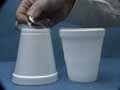

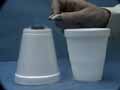

A 1-2-3 yttrium barium copper oxide superconducting pellet is cooled in liquid nitrogen and placed on an inverted foam cup. When a magnet is placed above the pellet, it is levitated by the superconductor.
 _Play
movie (28 seconds, 1.7 MB)
_Play
movie (28 seconds, 1.7 MB)

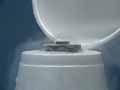
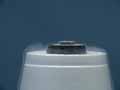
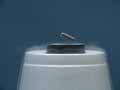
A magnet placed on the pellet that is above the superconductivity transition temperature does not float. Cooling the pellet through the phase change again levitates the magnet.
 _Play
movie (25 seconds, 1.5 MB)
_Play
movie (25 seconds, 1.5 MB)


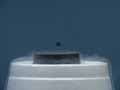
The magnet can be spun, showing the dynamic response of the magnetic field expulsion. Here plastic tweezers are used to spin the magnet.
Discussion
When cooled below a "critical" temperature, some substances lose all resistance to the flow of electrical current, becoming superconductors. A current induced in a superconducting material can flow forever, providing that the temperature remains below the critical temperature. Another property of a superconductor is its interaction with a magnetic field. A magnet induces a current in the superconductor, creating a magnetic field that repels the field of the magnet. This repulsive interaction is responsible for the levitation observed in the demonstration.
It has been determined that substances with the formula YBa2Cu3O7-x behave as superconductors at relatively high temperatures (above the boiling point of liquid nitrogen). The discovery of these materials was an important breakthrough, since liquid nitrogen is cheaper and easier to handle than the liquid helium required to bring low temperature superconductors below their critical temperatures. The designation 1-2-3 refers to the relative amounts of yttrium, barium and copper in the superconductor. Note that the compound is nonstoichiometric; that is, the subscript for oxygen is not an integer (in our compound x is a little less than 0.1). Note also that the material contains a mixture of Cu2+ and Cu3+ ions.
Superconductors are already employed in instruments requiring large magnetic fields, such as nuclear magnetic resonance spectrometers. Other potential applications include resistanceless power transmission cables and levitated vehicles.
Additional still images for this topic
Demonstration Notes: Warnings, Safety Information, etc.
Exam and Quiz Questions
1. Why is liquid nitrogen necessary in this demonstration?
2. Why is the small magnet levitated?