
Vapor Pressure: Drinking Bird
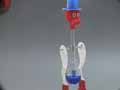
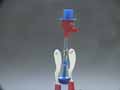
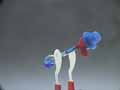
A novelty store "Drinking Bird" repeatedly dips is beak into a beaker of water and then bobs back to an upright position. Visible movement of a liquid in the bird's body accompanies the bobbing; the movement is caused by changing vapor pressure of the liquid due to different temperatures at the bird's head and the bird's body. Using a heat lamp on the head does not cause bobbing, but using a heat lamp on the body does cause bobbing.
Keywords
vapor pressure and temperature, liquids, evaporation, vapor pressure, evaporative cooling, solids and liquids, gases
Multimedia
Introduction
 _Play
movie (36 seconds, 2.1 MB)
_Play
movie (36 seconds, 2.1 MB)
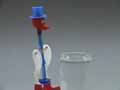
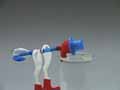
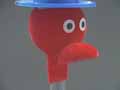
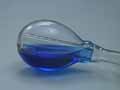
This drinking bird is available in some novelty stores. The vapor
pressure differential between the head and the base causes the
liquid to rise in the neck. When the liquid enters the head, it
causes the bird to tip over into the water for another drink. The
bird's head is covered with a material that absorbes water. The
base is closed at the top and so the only way that liquid and
vapor can escape is through the tube which extends almost to the
bottom of the base.
Effect of heat
 _Play
movie (47 seconds, 2.6 MB)
_Play
movie (47 seconds, 2.6 MB)
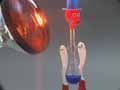
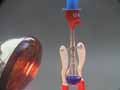
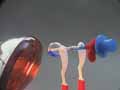
Heating the head of the bird forces the liquid into the base. This does not help the bird move.
Heating the liquid in the base causes an increase of the vapor pressure in the base. This causes a change in the differential of the vapor pressure between the head and the base, which causes the liquid to rise in the tube, ultimately causing the bird to tip over and drink.
Effect of water (condensation/cooling)
 _Play
movie (1 minute 15 seconds, 4.3 MB)
_Play
movie (1 minute 15 seconds, 4.3 MB)
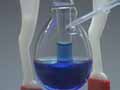
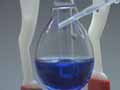
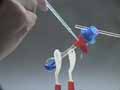
Evaporating water cools the liquid in the base. This lowers the vapor pressure and pulls the liquid back into the base.
Evaporating water cools the head of the bird. This decreases the vapor pressure in the head. The vapor pressure difference between the head and the base pulls the liquid into the head, ultimately causing the bird to tip over and drink.