
Vapor Pressure: Collapsing Balloon
A small amount of water is placed in one of two Erlenmeyer flasks on a hot plate. After the water has boiled balloons are fitted to the tops of the flasks and the flasks are allowed to cool. After a short time the balloon on the flask containing water is drawn into the flask as the water vapor condenses to form liquid water; the balloon on the other flask remains unchanged.
Keywords
water vapor, vapor pressure
Multimedia
 _Play
movie (1 minute 1 second, 3.5 MB)
_Play
movie (1 minute 1 second, 3.5 MB)
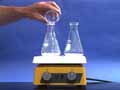
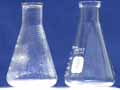
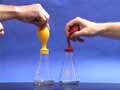
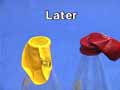
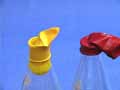
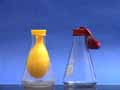
Water is poured into the left one of two Erlenmeyer flasks on a hot plate. The heat is turned on. Eventually the water boils, filling the left flask with water vapor. Balloons are mounted onto the tops of the flasks and the flasks are removed from the hot plate. The still expanding steam causes the left balloon to stand upwards. As the gas in the balloons cools, the balloon on the left collapses.
Still later, as the gas cools further, the balloon (on the left) is sucked into the flask.