
Plastic Sulfur
Yellow powdered sulfur is heated until it becomes molten and brown. At first it flows freely, but then it becomes very viscous. Upon further heating, the viscous sulfur flows freely again and ignites. The burning liquid sulfur is poured into a beaker of water. When removed from the water, the sulfur is rubbery and flexible.
(102 )
Keywords
allotropes, polymers, elements that exist as molecules, descriptive chemistry - sulfur, matter, bonding, solids and liquids, nonmetals, phase changes, physical properties, rubber
Multimedia
Part 1 of 5
 _Play
movie (18 seconds, 1 MB)
_Play
movie (18 seconds, 1 MB)
This demonstration illustrates some of the properties of the element sulfur. At room temperature sulfur is a yellow solid and consists of S8 molecules packed in a crystal lattice. When some powdered sulfur is placed into a beaker the pale yellow color is evident.
Part 2 of 5
 _Play
movie (27 seconds, 1.7 MB)
_Play
movie (27 seconds, 1.7 MB)
The solid material in the beaker is then heated in a bunsen burner flame. As the solid is heated, it begins to melt and a reddish brown liquid forms. The liquid flows freely. The melting point is 113 degrees Celsius. At this temperature the liquid consists of S8 molecules slightly farther apart and more randomly arranged than in the solid.
Part 3 of 5
 _Play
movie (31 seconds, 1.9 MB)
_Play
movie (31 seconds, 1.9 MB)
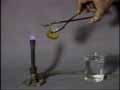
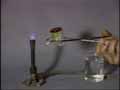
As it is heated further, to 180 degrees Celsius, the liquid that originally was freely flowing starts to thicken and after a short time becomes so viscous that the beaker can be inverted without any liquid flowing out. This behavior is attributed to breaking of bonds in the S8 rings so that long chains of S atoms form. These wrap around each other like strands of spaghetti in a bowl and prevent the liquid from flowing.
Part 4 of 5
 _Play
movie (35 seconds, 2.1 MB)
_Play
movie (35 seconds, 2.1 MB)
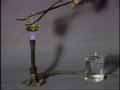
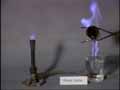
When the liquid is heated further, to 200 degrees Celsius, it becomes less viscous and again is able to flow. This is due to breaking of more S-S bonds to form shorter chains, which can move past each other more readily. Eventually, when the liquid is heated to 445 degrees Celsius, it begins to boil. The vapor ignites and there is a blue flame above the beaker. Now the liquid sulfur is poured out into a beaker of water.
Part 5 of 5
 _Play
movie (28 seconds, 1.7 MB)
_Play
movie (28 seconds, 1.7 MB)

The sulfur has become a flexible plastic that stretches considerably before it breaks. This happens because long chains of S atoms form as the sulfur is quickly cooled. Stretching the material straightens but does not break these chains.
Discussion
Chart with Temperature and Composition
|
445oC |
Boiling Point |
|
200oC |
Chains Shorten |
|
180oC |
Brown and Viscous |
|
160oC |
S8 breaks up, forms chains |
|
113oC |
Melting Point |
Additional still images for this topic
Demonstration Notes: Warnings, Safety Information, etc.
Exam and Quiz Questions
1. What is the formula of the allotrope of sulfur that was initially heated in the beaker?
2. What happened to the liquid sulfur when it was poured into the cold water?
3. Draw a picture of the molecules present in each case below:
a. In the solid sulfur before heating.
b. In liquid sulfur at a temperature just above the melting point.
c. In viscous liquid sulfur when the beaker is turned upside down.