
Induction by Iron(II) of the Oxidation of Iodide by Dichromate
Acidic aqueous solutions containing dichromate and iodide ions are mixed with no reaction. The addition of a solution of iron(II) ion induces the rapid formation of brown triiodide ion.
Keywords
catalyst, reaction rates, mechanism, triiodide ion, chromium(V), iron(V), redox reaction, transition elements, induction, kinetics, electronic structure, periodic table, oxidation and reduction, d block, rates of reaction
Multimedia
 _Play
movie (36 seconds, 2.2 MB)
_Play
movie (36 seconds, 2.2 MB)
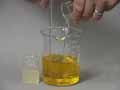
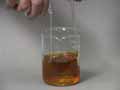
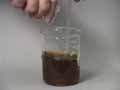
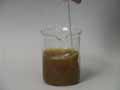
When acidic dichromate and iodide solutions are mixed, no
immediate reaction takes place, even though the electrochemical
potentials predict that chromium(VI) should oxidize iodide to
triiodide ion.
Addition of iron(II) solution brings about rapid formation of brown triiodide. A reasonable hypothesis for the mechanism is that dichromate oxidizes iron(II) to iron(III), and that iron(III) then oxidizes iodide to triiodide. How would you test this hypothesis?
 _Play
movie(23 seconds, 1.4 MB)
_Play
movie(23 seconds, 1.4 MB)
To test the hypothesis, an acidified iron(III) solution is added
to iodide solution. No formation of brown triiodide is observed.
Can you devise mechanisms involving the initial formation of
chromium(V) or iron(V) intermediates that will account for the
induction of the reaction by iron(II)?