
Colors of Elements in a Flame
Aqueous solutions of various compounds are sprayed into a Meeker burner flame from an atomizer. The flame colors are demonstrated close up. Except for boric acid, all compounds are chlorides. Aluminum chloride or magnesium chloride can be used to demonstrate that chlorine imparts no color to the flame.
(138 )
Keywords
electronic structure of atoms, electron energy, electronic structure, periodic table, emission spectrum, spectroscopy, descriptive chemistry - metals
Multimedia
Aluminum Chloride
 _Play movie (.8M)

No color is imparted to the flame by aluminum chloride. This indicates that neither aluminum nor chlorine has a characteristic flame color. A few tinges of yellow-orange sodium color appear as a consequence of traces of sodium impurity in the aluminum chloride solution.
Boric Acid
 _Play movie (0.2 MB)
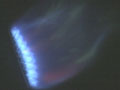
A very pale green color is imparted to the flame by boron in boric acid. A few tinges of yellow-orange sodium color appear as a consequence of traces of sodium impurity in the boric acid solution. The intensity of the boron flame color can be increased by burning boron-containing samples in alcohol, but for consistency with the other tests, this was not done here.
Calcium Chloride
 _Play movie (0.2 MB)

A yellowish-red color is imparted to the flame by calcium chloride. The color is not as bright yellow as the sodium flame color.
Cobalt(II) Chloride
 _Play movie (0.2 MB)

No color is imparted to the flame by cobalt(II) chloride, but a large number of incandescent flashes shoot out with the stream of burning gas. Since these are white, they contain all colors of the visible spectrum, not the characteristic line spectrum of cobalt. A few tinges of yellow-orange sodium color appear as a consequence of traces of sodium impurity in the cobalt(II) chloride solution.
Copper(II) Chloride
 _Play movie (0.2 MB)
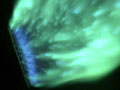
A bright green color is imparted to the flame by copper(II) chloride. The color is so bright that in some cases it appears white. Usually copper salts other than the chloride are emerald green and copper chlorides are azure blue, but in this case the chloride appears emerald green.
Lithium Chloride
 _Play movie (0.2 MB)
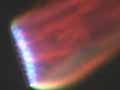
A carmine-red color is imparted to the flame by lithium chloride. The color is less intense than the strontium flame color. A few tinges of yellow-orange sodium color appear as a consequence of traces of sodium impurity in the lithium chloride solution.
Magnesium Chloride
 _Play movie (0.2 MB)

No color is imparted to the flame by magnesium chloride. This indicates that neither magnesium nor chlorine has a characteristic flame color. A few tinges of yellow-orange sodium color appear as a consequence of traces of sodium impurity in the magnesium chloride solution.
Manganese(II) Chloride
 _Play movie (0.2 MB)
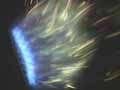
A pale yellow-green color is imparted to the flame by manganese(II) chloride, but a large number of incandescent flashes shoot out with the stream of burning gas. Since these are white, they contain all colors of the visible spectrum, not the characteristic line spectrum of manganese. A few tinges of yellow-orange sodium color appear as a consequence of traces of sodium impurity in the manganese(II) chloride solution.
Sodium Chloride
 _Play movie (0.2 MB)

(138 )
A bright yellow-orange color is imparted to the flame by sodium chloride.
Strontium Chloride
 _Play movie (0.2 MB)

A scarlet-red color is imparted to the flame by strontium chloride. The color is brighter red than the lithium flame color.
Animation of Photon Emission
 _Play
movie (36 seconds, 2.4 MB)
_Play
movie (36 seconds, 2.4 MB)

The animation is highly schematic. It shows a set of energy levels for a hydrogen-like (one-electron) atom or ion. Collisions of an atom with other fast-moving atoms in the flame can raise an atom to an excited state, after which the atom can lose energy by emitting a photon. The color (wavelength) of the photon depends on the energy difference between the upper and lower energy levels.
(100 )
Discussion
The movies are actually only 3 to 5 seconds in length but are looped for continuous play. There is no sound or voice over.
Metal salts introduced into a flame give off light characteristic of the metal. Metal ions combine with electrons in the flame and the metal atoms are raised to excited states because of the high flame temperature. Upon returning to the ground state, they give off light (a line spectrum) characteristic of that metal.
Several metal salts give off a characteristic color visible to the human eye as is demonstrated by the alkali metals and a few other elements, but a fair number of metal salts give off light that may be observed, but is not sufficiently different in color to be differentiated from other metal salts. Some metal salts give off light outside of the visible region of the electromagnetic spectrum.
In these video sequences selected compounds, mostly metal salts, show the flame color in a Meeker burner flame. A homemade atomizer was used to form a fine spray of the solution, which was sprayed directly into the burner flame.
It should be noted that sodium is present as an impurity in many if not most metal salts. Because sodium imparts an especially intense color to a flame, flashes of the sodium may be observed in nearly all solutions tested.
Additional still images for this topic