
Curie Point of Nickel
At room temperature nickel is ferromagnetic, and a nickel sphere is attracted to a hanging magnet. When the sphere is heated to above 627 K, it is no longer attracted to the magnet, but after cooling it once again becomes ferromagnetic, and jumps up to the hanging magnet.
(114 )
Keywords
ferromagnetism, phase changes, physical properties, magnetic properties, solid state, electronic structure, periodic table, metals, bonding, d block, transition elements
Multimedia
 _Play movie (32 seconds, 1.9 MB)
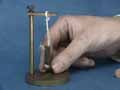
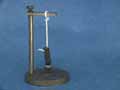



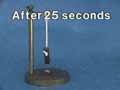
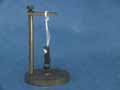
Nickel is ferromagnetic. Domains of electrons align causing the
nickel sphere to be attracted to the hanging magnet. Heating the
nickel sphere scrambles the alignment of the electrons, and the
sample is no longer attracted to the magnet. After the nickel sphere
has cooled on the brass plate to below 627 Kelvin, the electrons
realign and the ferromagnetism returns.
Absence of a magnetic
field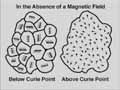
Alignment of spins below and above 627 K in the absence of a magnetic field are shown.
Presence of a magnetic
field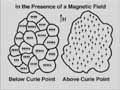
Alignment of spins below and above 627 K in the presence of a magnetic field are shown.
Discussion
In contrast to paramagnetic substances, the unpaired electrons in ferromagnetic substances interact strongly and are aligned with one another in large domains, even in the absence of an applied magnetic field. (See first still.) In the presence of a magnetic field the domains align with one another, (See second still) and the substance is strongly attracted by the field. In permanent magnets, the alignment of the individual domains with one another is retained even in the absence of an applied magnetic field.
Additional still images for this topic
Demonstration Notes: Warnings, Safety Information, etc.
Exam and Quiz Questions
1. What happens to the alignment of spins of the unpaired electrons when the nickel sphere is heated above the Curie point?
2. Draw pictures of the spin alignments above and below the Curie point.