
Hardness of Solid Substances - Grinding
A number of metals and nonmetals are ground with a mortar and pestle. The nonmetals shown here are all soft (due to weak intermolecular forces), but the metals vary in hardness. Models of some of the elements at the atomic level are shown.
(99 )
Keywords
crystal lattice, intermolecular forces, solid state structures, elements, elements that exist as molecules, metals, nonmetals, bonding, solids and liquids
Multimedia
Grinding Graphite
 _Play
movie (5 seconds, 0.3 MB)
_Play
movie (5 seconds, 0.3 MB)
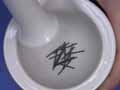

Graphite can easily
be crushed into small pieces.
Layer structure of graphite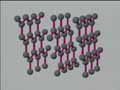
Grinding Magnesium
 _Play
movie (5 seconds, 0.3 MB)
_Play
movie (5 seconds, 0.3 MB)
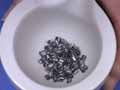

Magnesium metal is
not easily ground or crushed.
Grinding Sulfur
 _Play
movie (5 seconds, 0.3 MB)
_Play
movie (5 seconds, 0.3 MB)

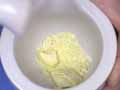
Sulfur can easily
be ground to a fine powder.
Grinding Iron
 _Play
movie (6 seconds, 0.4 MB)
_Play
movie (6 seconds, 0.4 MB)
Iron metal is not
easily ground or crushed.
Iron crystal structure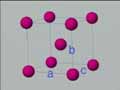
Grinding Zinc
 _Play
movie (5 seconds, 0.3 MB)
_Play
movie (5 seconds, 0.3 MB)
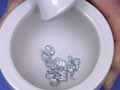
Zinc metal is not
easily ground or crushed.
Grinding Selenium
 _Play
movie (5 seconds, 0.3 MB)
_Play
movie (5 seconds, 0.3 MB)
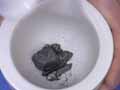
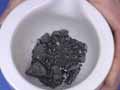
Selenium can
easily be ground to a powder.
Grinding Tin
 _Play
movie (6 seconds, 0.4 MB)
_Play
movie (6 seconds, 0.4 MB)

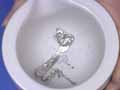
Tin is a
relatively soft metal that can be flattened.
Grinding Iodine
 _Play
movie (6 seconds, 0.4 MB)
_Play
movie (6 seconds, 0.4 MB)
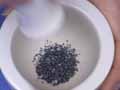
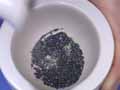
Iodine can be
ground to coarse grains.
Iodine crystal structure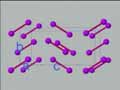
Grinding Lead
 _Play
movie (7 seconds, 0.5 MB)
_Play
movie (7 seconds, 0.5 MB)
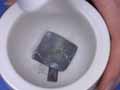
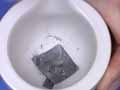
Lead is a
relatively soft metal that can be flattened.
Lead crystal structure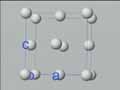
Discussion
The following discussion applies to both part 1 and part 2 of this topic (ie. hardness of solid substances).
The hardness of a substance depends on the nature and strength of the bonds that bind the atoms, molecules or ions in a crystal lattice. Three-dimensional covalent network solids such as diamond and silicon are hard and brittle because the bonds holding the crystal together are quite strong. Since the strength of these bonds depends on good overlap of the valence orbitals, attempts to deform the solids will rupture the bonds and result in a breaking of the crystal, as is seen in the case of silicon. Graphite is a two-dimensional covalent network solid. Although the bonds within the hexagonal layers are very strong, only weak London forces must be overcome when sliding the layers past one another; hence graphite is a soft material. Similarly, the intermolecular forces holding the helical chains of selenium together are weak, so this substance is also soft. Like most molecular substances, sulfur and iodine are easily crushed.
In molybdenum disulfide the covalent bonds between molybdenum and sulfur atoms are strong, but the sulfur atoms on adjacent layers are bound only by weak London forces. Thus, it is easy to peel MoS2 into very thin sheets.
Although metal atoms are bound by a sea of delocalized electrons, the strengths of the bonds vary widely, depending in part on the size of the metal atoms and the number of bonding electrons. Thus, lithium is easily cut, lead and tin may be flattened when pressure is applied, while magnesium, iron and zinc are so hard that they cannot be ground with a mortar and pestle. Lead and tin may be deformed without breaking, since the strengths of metallic bonds are much less sensitive to the positions of the atoms than are the strengths of covalent bonds. The hardness of a metal is not related to its crystal structure. Although lithium is soft and iron is hard, both metals have body centered cubic lattices. A face centered cubic (cubic closest packing) unit cell of lead is also shown.
Additional still images for this topic
Demonstration Notes: Warnings, Safety Information, etc.
Exam and Quiz Questions
1. Do all of the metal samples behave the same when crushed? Why might different kinds of metals differ in hardness?
2. Which of the nonmetals are hard? Which are soft? Examine their models and account for the differences between the hard and soft nonmetals.
3. Some of the softer metals simply deformed when pressure was applied, but silicon shattered. How does the bonding in metals and in silicon account for their different behavior?