
Ferrimagnetism
Precipitation reactions are used to produce iron(III) oxide (Fe2O3 called hematite) and mixed iron(II)/iron(III) oxide (Fe3O4 called magnetite). The particles in the slurry of hematite are not attracted to a magnet, but the particles in the slurry of magnetite are.
Keywords
precipitation, solubility, magnetic properties, ferrimagnetic, hematite, magnetite, magnetism, transition elements, bonding, metals, d block
Multimedia
 _Play
movie (40 seconds, 2.5 MB)
_Play
movie (40 seconds, 2.5 MB)
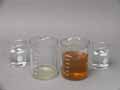
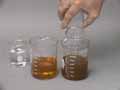
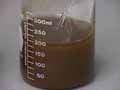
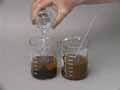
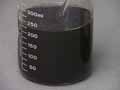
One hundred milliliters of 0.1 molar iron(III) ammonium sulfate
are added to fifty milliliters of 0.1 molar iron(II) ammonium
sulfate. Addition of aqueous ammonia to the iron(III) solution
gives brown iron(III) oxide, called hematite. Addition of ammonia
to the iron(II)/iron(III) mixture gives black
Fe3O4, called magnetite.
 _Play
movie (32 seconds, 1.9 MB)
_Play
movie (32 seconds, 1.9 MB)
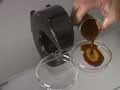
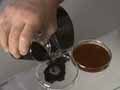

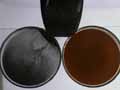
Later the two substances are tested for magnetism. When the brown
hematite is placed near a magnet, no interaction is observed.
However, magnetite particles are strongly attracted, because the
substance is ferrimagnetic.