
Heat Conduction by Diamond
A synthetic diamond wafer and an aluminum disk are held between a thumb and forefinger (to provide heat). When pressed against an ice cube, the diamond penetrates more rapidly than does the aluminum.
Butter is used to glue a piece of pasta to each disk. When the edges of the disks are immersed in hot water, the butter on the diamond melts more rapidly, releasing the piece of pasta.
(118 )
Keywords
physical properties, solid state structures, properties of elements, solids and liquids, metals, nonmetals, bonding
Multimedia
With ice cube
 _Play
movie (15 seconds, 0.9 MB)
_Play
movie (15 seconds, 0.9 MB)
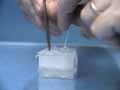

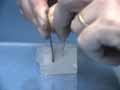
A synthetic diamond wafer and an aluminum disk are lowered onto an
ice cube. Thermal transfer from the hands holding the disks melts
the ice. Diamond conducts heat more efficiently than aluminum.
With butter
 _Play
movie (14 seconds, 0.9 MB)
_Play
movie (14 seconds, 0.9 MB)
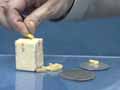



Butter is used to glue pieces of pasta to a diamond disk and an
aluminum disk. Simultaneously lowering the edges of the two disks
into hot water results in more rapid melting of the butter on the
diamond disk on the left.
Discussion
Because of the mobility of their valence electrons throughout the entire crystal, metals are good thermal conductors. Why then is diamond, a covalent network solid with localized valence electrons, a better conductor of heat than aluminum? In this case the mechanism of heat transfer involves high energy atomic vibrational states. Covalent and ionic substances with strong ("stiff") bonds typically have high thermal conductivities.
Additional still images for this topic
Demonstration Notes: Warnings, Safety Information, etc.
Exam and Quiz Questions
1. What causes the diamond and aluminum disks to melt through the ice cube?
2. Would you expect the demonstrator's hand to feel a hot or cold sensation as the diamond melted through the ice?
3. How does the diamond melt through the ice cube?