
Relative Reactivity of Alkali Metals
Small chunks of lithium, sodium and potassium react with water, generating hydrogen gas and turning phenolphthalein indicator pink. The reactivities of the three metals with water are compared.
(91 )
Keywords
descriptive chemistry, indicators, elements, reactivity, safety, evidence of chemical reaction, periodic trends, reaction rates, redox reaction, periodic table, oxidation and reduction, metals, rates of reaction
Multimedia
Reaction of Lithium with Water
 _Play movie (38 seconds, 2.2 MB)

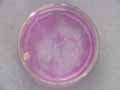
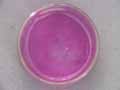
A small chunk of lithium metal is placed in a dish of water
containing phenolphthalein indicator. The lithium skims along the
liquid surface, and hydrogen gas is generated. The water turns pink
as the reaction progresses because lithium hydroxide, a base, is also
produced.
Reaction of Sodium with Water
 _Play movie
(30 seconds, 1.8 MB)
_Play movie
(30 seconds, 1.8 MB)
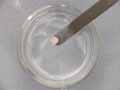
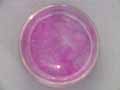
The reaction of sodium metal with water is more vigorous than
lithium's reaction. Note that the sodium almost immediately melts,
and then skims the surface more rapidly than the lithium did. The
products of sodium's reaction with water are hydrogen gas and sodium
hydroxide, the base that turns the phenolphthalein pink.
Reaction of Potassium with Water
 _Play movie
(6 seconds, 0.4 MB)
_Play movie
(6 seconds, 0.4 MB)
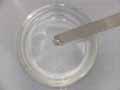
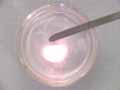
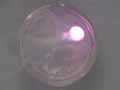
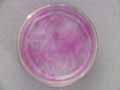
Potassium's reaction with water is much more vigorous than sodium's.
Reactions of All Three Metals
 _Play movie
(51 seconds, 2.8 MB)
_Play movie
(51 seconds, 2.8 MB)
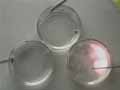
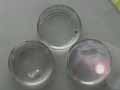
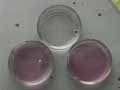
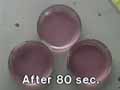
Labeled Li, Na and K
reactions 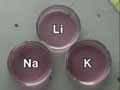
Discussion
Additional still images for this topic
Demonstration Notes: Warnings, Safety Information, etc.
Exam and Quiz Questions
1. What is the trend in the reactivity of the three alkali metals with water?
2. Write a balanced chemical equation for the reaction of lithium with water.
3. In the last demonstration, the three metals are lithium, sodium and potassium. Which metal is which?