The strip of zinc metal shown in Self Check video 1 was used in a nickel/zinc cell. Although the expected potential for this cell is 0.513 V (as calculated from standard reduction potentials in the electrochemical series), the measured potential was only 0.326 V. Explain this discrepancy.
Answer
If you look closely at the metal strip, you can see that it is not very shiny. Before the electrochemical cell was assembled, the metal strip should have been sanded. Because the strip was not cleaned prior to use, an oxide layer coated the zinc and prevented an accurate
measurement of the cell potential.
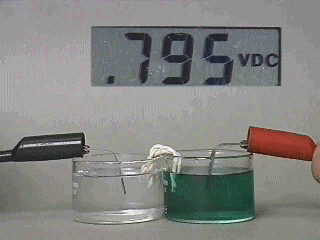
Explain why the cell potential is zero for the cell in Self Check video 2.
Answer
The solutions in the cell are not connected by a salt bridge. Without a salt bridge, positive charges that would form in one compartment and negative charges that would form in the other compartment
cannot be balanced with counterions from the salt bridge. Because the compartments cannot contain net charges, electrons never flow from one compartment to the other.
Explain why the experimental design shown in Self Check video 3 will not work to measure a cell potential correctly.
Answer
Both electrodes were placed into the same salt solution. To measure a cell potential, each metal should be placed into a solution of its salt. The two salt solutions should be connected by the salt bridge.


 The strip of zinc metal shown in Self Check video 1 was used in a nickel/zinc cell. Although the expected potential for this cell is 0.513 V (as calculated from standard reduction potentials in the electrochemical series), the measured potential was only 0.326 V. Explain this discrepancy.