
Vapor Pressure: Using Barometers
The measurement of pressure exerted by a vapor is demonstrated using barometers. The vapor pressures of water and ethanol are compared. Vapor pressure varies with the strength of the intermolecular forces in the liquid. In this case the number of hydrogen bonds per molecule is different, and more hydrogen bonds means greater intermolecular forces. Also each hydrogen bond between water molecules is stronger than a hydrogen bond between ethanol molecules.
(94 )
Keywords
vapor pressure, atmospheric pressure, barometric pressure, barometer, intermolecular forces, hydrogen bond, gases and liquids, organic, phase changes, physical properties
Multimedia
 _Play
movie (2 minutes 20 seconds, 6.9 MB)
_Play
movie (2 minutes 20 seconds, 6.9 MB)
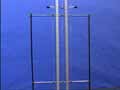
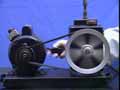
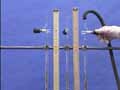
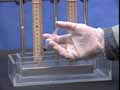
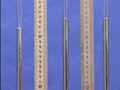
Pressure exerted by a vapor can be measured using barometers. Mercury is poured into a dish below the three barometer tubes. A vacuum pump is used to create a vacuum at the top of the tube, and draw the mercury into it. When the tube is evacuated, the valve is closed, and the pump is turned off. Here the height of the mercury is 736 millimeters.
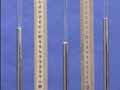
A syringe is filled with water. The water is carefully injected into the open end of the barometer (by going underneath the pool of mercury.) The liquid rises up to the top of the mercury column. When it reaches the vacuum at the top of the barometer, some of the liquid will vaporize. This depresses the column of mercury to 716 millimeters. (The difference in the height of the mercury column before and after injecting the liquid is the vapor pressure of the liquid.) The vapor pressure of water is 20 millimeters of mercury.
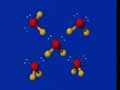
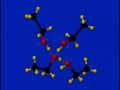
A single water molecule can form hydrogen bonds between itself and 4 other water molecules. Vapor pressure varies with the strength of the intermolecular forces in the liquid. Ethanol can only form 3 hydrogen bonds, and they are not as strong as the hydrogen bonds in water. When ethanol is injected, the ethanol rises to the top and vaporizes. The mercury is depressed to 686 millimeters, more than it was with water. More ethanol has vaporized indicating that it has weaker intermolecular forces than water.