
Viscosity of Liquids
Qualitative test: Four pipets are filled with different liquids. When the liquids are released, they are observed to flow at different rates.
Capillary length test: Four funnels are filled with water and attached to capillary tubing of various lengths. The longer the capillary tube, the slower the rate of flow of the water.
Measuring relative viscosity: The rate of flow of six different liquids through a Mohr pipet is determined. The experiment is set up so that the times at which the liquid reaches the 0 mL and 3 mL marks on the pipet may be observed. The rate of flow depends on the size and shape of the molecules as well as on the types of intermolecular forces involved.
(86 )
Bubble: An air bubble moving in a liquid in a test tube is demonstrated.
(135 )
Keywords
intermolecular forces, polarity, polar molecules, physical properties, gases and liquids, bonding, solids and liquids, organic
Multimedia
Qualitative Test
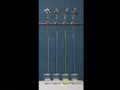
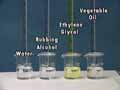
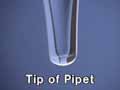
Apparatus, Labeled Samples (water, rubbing alcohol, ethylene glycol, vegetable oil), and Tip of Pipet
The narrow point is responsible for restriction of liquid flow.
 _Play
movie (21 seconds, 1.2 MB)
_Play
movie (21 seconds, 1.2 MB)
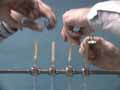
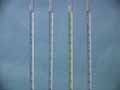
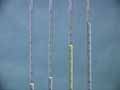
The flow of liquid from four pipets is started simultaneously to test their viscosity. Since viscosity is the resistance to flow, the liquid on the left is least viscous, and the viscosity increases from left to right.
(Note: the viscosity of the liquids, not the pipets, is being tested.)
Capillary Length Test
Labeled lengths of capillary tubes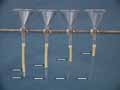
 _Play
movie (31 seconds, 1.4 MB)
_Play
movie (31 seconds, 1.4 MB)
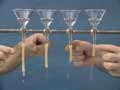
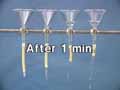
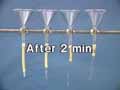
Four funnels, each containing ten milliliters of water, are connected to differing lengths of capillary tubing. Note that the flow rate is greatest in the apparatus with the shortest capillary tube. The greater the length of the capillary tube, the longer it takes for the water to flow through the apparatus.
Measuring Relative Viscosity
Introduction
 _Play
movie (4 seconds, 0.3 MB)
_Play
movie (4 seconds, 0.3 MB)
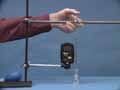
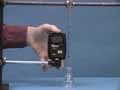
This is an introductory movie showing, in wider angle, the manner in which the experiment is performed.
With the following movies, it is possible to determine the relative viscosities of the water, hexane, octane, 2,2,4-trimethylpentane (isooctane) and 1-pentanol from measurements of the times when the meniscus passes the zero and 3 mL marks on the pipet. Viscosity is inversely proportional to the elapsed time.
Water
 _Play
movie (9 seconds, 0.4 MB)
_Play
movie (9 seconds, 0.4 MB)
From the stopwatch, obtain the times when the meniscus passes the zero and three milliliter mark.
Hexane
Molecular structure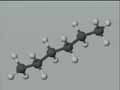
 _Play
movie (5 seconds, 0.2 MB)
_Play
movie (5 seconds, 0.2 MB)
Obtain the times when the meniscus passes the zero and three milliliter mark.
Octane
Molecular structure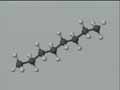
 _Play
movie (6 seconds, 0.3 MB)
_Play
movie (6 seconds, 0.3 MB)
From the stopwatch, obtain the times when the meniscus passes the zero and three milliliter mark.
2,2,4-Trimethylpentane (isooctane)
Molecular structure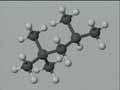
 _Play
movie (7 seconds, 0.3 MB)
_Play
movie (7 seconds, 0.3 MB)
From the stopwatch, obtain the times when the meniscus passes the zero and three milliliter mark.
1-Pentanol
Molecular structure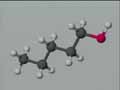
 _Play
movie (29 seconds, 1.3 MB)
_Play
movie (29 seconds, 1.3 MB)
From the stopwatch, obtain the times when the meniscus passes the zero and three milliliter mark.
(86 )
Discussion
Relative Viscosities of Liquids
The rate of flow of a liquid depends on the magnitude of the intermolecular forces and the shapes of the molecules. All molecules experience London forces, due to the polarizability of the electron cloud. Since hexane is smaller than octane, its intermolecular forces are weaker and it flows more rapidly. Although the sizes of the octane and 2,2,4-trimethylpentane (called isooctane because it is an isomer of octane) molecules are similar, the more compact isooctane molecule experiences smaller forces than the straight-chain n-octane molecule. In general, branch-chained isomers are less viscous and have lower boiling points than straight-chain isomers.
Although water molecules are much smaller than hexane molecules, water is more viscous than hexane. This is due to the hydrogen-bonding in water, a much stronger intermolecular attraction than the London force. Compare the hexane and 1-pentanol molecules. Both have similar sizes and shapes, so the London forces should be similar. However, 1-pentanol is much more viscous, due to the hydrogen-bonding between the OH groups at the end of the molecules.
Qualitative Tests
The same general principles apply in this demonstration. Each of the first three substances can form hydrogen-bonds. Rubbing alcohol molecules (2-propanol) are significantly larger than those of water, so their greater London forces result in a higher viscosity. Rubbing alcohol and ethylene glycol (HOCH2CH2OH) molecules will have similar London forces, but with two hydroxyl groups, ethylene glycol molecules form twice as many hydrogen bonds as those of 2-propanol, so ethylene glycol is more viscous. The molecules in vegetable oil form no hydrogen bonds, but their large size means that the London forces are very strong and the liquid is extremely viscous.
Additional still images for this topic
Demonstration Notes: Warnings, Safety Information, etc.
Exam and Quiz Questions
Qualitative Test
1. The four liquids in the demonstration are vegetable oil, water, ethylene glycol and 2-propanol. Which is which?
Relative Viscosities of Liquids
1. Use the times obtained from the stopwatch to determine the relative viscosities of the five liquids.
2. Examine the molecular models, and decide what properties of molecules affect viscosity.
3. Compare the viscosities of hexane and octane. Examine the molecular models and explain the difference in viscosity.
4. Compare the viscosities of octane and 2,2,4-trimethylpentane (isooctane). Examine the molecular models and explain the difference in viscosity.
5. Compare the viscosities of hexane and 2-pentanol. Examine the molecular models and explain the difference in viscosity.
6. Explain the difference between the viscosities of water and n-hexane.