
Paramagnetism: Oxidation States of Manganese
Manganese(III) oxide, with 4 unpaired electrons per Mn atom, is more strongly attracted to a magnet than is manganese(IV) oxide, with only 3 unpaired electrons per Mn atom. Potassium permanganate, a compound of Mn(VII), has no unpaired electrons and is not attracted to a magnet.
(115 )
Keywords
electron configuration, paramagnetism, magnetic properties, diamagnetism, oxidation numbers, solid state, electronic structure, periodic table, d block, transition elements
Multimedia
Mn2O3
 _Play
movie (7 seconds, 0.4 MB)
_Play
movie (7 seconds, 0.4 MB)
Manganese (III) oxide is paramagnetic with 4 unpaired electrons.
MnO2
_Play
movie (7 seconds, 0.4 MB)
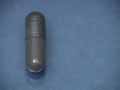
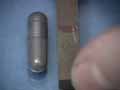
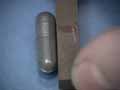
Manganese(IV) oxide is less paramagnetic, with only 3 unpaired electrons.
KMnO4
_Play
movie (7 seconds, 0.5 MB)
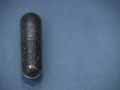
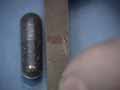
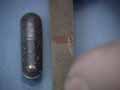
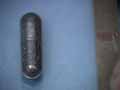
Potassium permanganate is diamagnetic with no unpaired electrons.
Discussion
Substances containing unpaired electrons are usually paramagnetic. In the presence of a magnetic field the spins of the unpaired electrons are aligned and the substance is attracted by the magnetic field. Since Mn2O3 has a high spin d 4 electron configuration, it is more strongly attracted by the magnet than MnO2, with a d 3 electron configuration. Since MnO4- contains Mn(VII) with a d 0 configuration, it is diamagnetic (no unpaired electrons). Diamagnetic substances are weakly repelled by a magnetic field, but the effect is too small to be observed without a much stronger magnet than the one used here.
Discussion
Additional still images for this topic
Demonstration Notes: Warnings, Safety Information, etc.
Exam and Quiz Questions
1. What is paramagnetism?
2. From what does paramagnetism result?
3. Use crystal field theory to account for the number of unpaired electrons in Mn2O3 and MnO2.
4. What is the oxidation state of manganese in KMnO4? How many valence electrons does the Mn atom have? Is this consistent with the diamagnetism of KMnO4?