
Isotopes: Heavy Water Ice Cubes
An H2O ice cube is shown to float in a beaker of liquid water, while an ice cube of D2O (heavy water) is shown to sink in liquid water.
(97 )
Keywords
isotopes, physical properties, density, descriptive chemistry - water, matter, solids and liquids, p block
Multimedia
H2O Ice Cube in Liquid H2O
 _Play
movie (6 seconds, 0.4 MB)
_Play
movie (6 seconds, 0.4 MB)
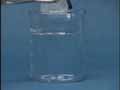
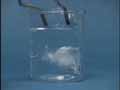
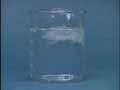
An ice cube made from normal water floats in a beaker of liquid
water.
D2O Ice Cube in Liquid H2O
 _Play
movie (8 seconds, 0.5 MB)
_Play
movie (8 seconds, 0.5 MB)
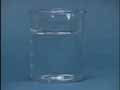
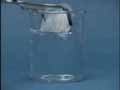
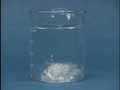
An ice cube of deuterium oxide (containing a heavier isotope of
hydrogen) sinks in water.
Some Comparisons
(The following two movies are similar, except that in the two movies the positions of the ice cubes are reversed. One reason this is done is that the movies, after having the sound removed, can be used for testing purposes.)
Comparison 1: H2O and D2O Ice Cubes in Liquid H2O
 _Play
movie (10 seconds, 0.6 MB)
_Play
movie (10 seconds, 0.6 MB)

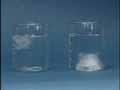
A normal ice cube is less dense than liquid water, but a deuterium
oxide ice cube is more dense than liquid water.
Comparison 2: D2O and H2O Ice Cubes in Liquid H2O
 _Play
movie (8 seconds, 0.5 MB)
_Play
movie (8 seconds, 0.5 MB)


An H2O ice cube is less dense than liquid water, but a
D2O ice cube is more dense than liquid water.
Discussion
The two movies in Some Comparisons are designed to be used in quizzes or examinations. They are similar, but the D2O cube is on the right in the first one and on the left in the second.
Additional still images for this topic
Demonstration Notes: Warnings, Safety Information, etc.
Exam and Quiz Questions
1. (D2O and H2O Ice Cubes in Liquid H2O) Assuming that both cubes were dropped into normal liquid water, which cube was normal water ice, and which was deuterium oxide ice?
2. (H2O and D2O Ice Cubes in Liquid H2O) Assuming that both cubes were dropped into normal liquid water, which cube was normal water ice, and which was deuterium oxide ice?
3. Deuterium oxide is made from the isotope of hydrogen that contains one neutron and one proton. Based on the video, name one property that is affected by the presence of this isotope. Do different isotopes of the same element have different chemical properties? Can different isotopes of the same element have different physical properties? Support your answer with evidence from the video.