
Sodium Chloride Crystal Cleavage
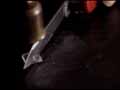
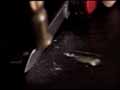
A knife is placed on a large sodium chloride crystal parallel to a cleavage plane. When the knife is tapped, the crystal breaks cleanly, creating two smaller crystals. When one of these crystals is tapped with the knife at an angle, it shatters, breaking along a cleavage plane rather than parallel to the knife blade. An atomic-scale animation of crystal cleavage follows.
(103 )
Keywords
crystal lattice, ionic compounds, ionic bonds, solid state structure, solids and liquids, bonding, matter
Multimedia
Demonstration
 _Play
movie (39 seconds, 2.4 MB)
_Play
movie (39 seconds, 2.4 MB)
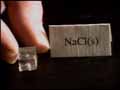
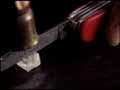
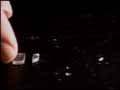
Here a small crystal of solid sodium chloride is shown. It is
transparent and has 90-degree angles at the sides. When a knife
blade is placed on it parallel to one side and tapped with a
hammer, the crystal cleaves into two pieces, each with a very
clean plane edge. Now the piece that was cleaved off of the
original piece is examined. The knife blade is placed on it at a
45-degree angle to a side and tapped with a hammer. The crystal
shatters, but part of it cleaves parallel to a side.
(103 )
Animation
 _Play
movie (19 seconds, 1 MB)
_Play
movie (19 seconds, 1 MB)
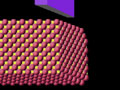
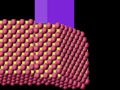
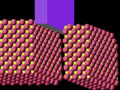
In this atomic-scale view of sodium chloride, when the crystal is
struck, ions with the same charge are moved near each other. Since
like charges repel, the crystal cleaves into two pieces along the
plane where it was struck.
Note: the smaller, yellow ions are Na+; the larger, orange ions are Cl-.
(100 )
Discussion
Additional still images for this topic
Demonstration Notes: Warnings, Safety Information, etc.
Exam and Quiz Questions
1. List as many observations as possible concerning this video segment.
1. Why does the sodium chloride cleave cleanly when the knife blade is placed on it parallel to a side and tapped, but shatter when the blade is placed at an angle to a side and tapped?
2. Describe the general shape of the sodium chloride crystal shown here. What clues does this shape give about the structure of the crystal at the atomic level?
3. Is sodium chloride a molecular or an ionic compound? What physical evidence supports your answer?
Animation
1. Based on this animation, do like charges attract or repel each other?
2. Based on this animation, describe in words what is happening at the atomic level to cause the sodium chloride crystal to cleave along the plane that it does?
3. Based on this animation, describe in words why the crystal of sodium chloride shattered when the knife blade was placed at a 45-degree angle to a face and tapped with a hammer.