
Boyle's Law: J-tube
This is a demonstration of Boyle's law. The relationship between the volume of a gas and the pressure it exerts is shown with a J-tube.
(143 )
Keywords
atmospheric pressure, barometric pressure, barometer, Boyle's law, J-tube, gas laws
Multimedia
 _Play
movie (26 seconds, 4.2 MB)
_Play
movie (26 seconds, 4.2 MB)
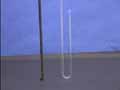
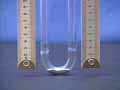
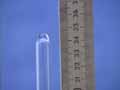
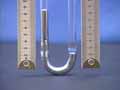
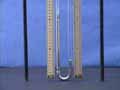
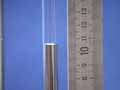
The relationship between the volume of a gas and the pressure it exerts can be studied by adding mercury to a J-tube until the height of the mercury is equal on both sides and a sample of gas is trapped. The pressure in the closed portion of the tube now equals atmospheric pressure. The cylinder of trapped air is 34 centimeters high, and its volume is proportional to its height.
The first addition of mercury raises its height on the left to 8.6 centimeters. The pressure of the trapped air goes up and prevents the mercury from rising above 2.2 centimeters on the right. Adding 25.9 centimeters of mercury on the left gives a height of 6.7 centimeters on the right, and 45.9 centimeters corresponds to 10.7 centimeters.
The difference between heights of mercury plus atmospheric pressure equals the pressure on the gas. By plotting the experimental values for the pressure vs. the reciprocal of the volume of air, we get a straight line. The inverse proportionality between volume and pressure is known as BoyleÕs law.