
Ammonia Fountains - Multiple
A separatory funnel, four round-bottomed flasks, and some tubing form a closed system. One end of the tubing is immersed in an acetic acid solution that contains universal indicator. The glassware has been filled with ammonia gas. The stopcock of the funnel is closed. A small amount of water is added to the funnel above the closed stopcock. The stopcock is opened and then closed, introducing the water and then closing the system. Ammonia gas dissolves into the water, reducing the pressure in the system of flasks. Atmospheric pressure pushes the acetic acid solution into the system. Ammonia gas dissolves into the solution, neutralizing the acid and turning the solution basic. As more acetic acid solution is introduced into the system, the colors continue to change. At equilibrium, the pH and therefore the color is dependent on the relative amount of ammonia gas dissolved in the solution.
(98 )
Keywords
solubility, soluble, descriptive chemistry - ammonia, pH, indicators, acids and bases, universal indicator, ammonia solubility, acetic acid, gases, solution of a gas in a liquid
Multimedia
 _Play
movie (1 minute, 7 seconds, 3.9 MB)
_Play
movie (1 minute, 7 seconds, 3.9 MB)
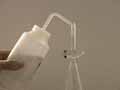
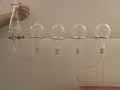
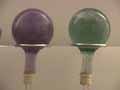
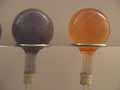
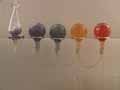
A small amount of water is added to a separatory funnel above the closed stopcock. The stopcock is opened and then closed, introducing the water and then closing the system. Ammonia gas dissolves into the water reducing the pressure in the system of flasks. Atmospheric pressure pushes the acetic acid solution into the system. Ammonia gas dissolves into the solution neutralizing the acid and turning the solution basic. As more acetic acid solution is introduced into the system, the colors continue to change. At equilibrium, the pH, and therefore the color, is dependent on the relative amount of ammonia gas dissolved in the solution.
 _Play
movie (25 seconds, 1.3 MB)
_Play
movie (25 seconds, 1.3 MB)
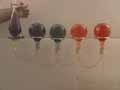
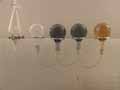
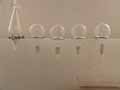
As the liquid flows out of the system, we see the process in reverse. (Note, this movie consists of brief snapshots of the experiment.)
Discussion
Additional still images for this topic