
Solutions
Sugar Water
 Play movie (11 seconds, .6 MB)
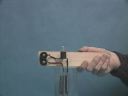
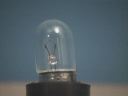

When wires connected to a light bulb and battery are placed into sugar water, the light bulb does not light. Sugar is a non electrolyte.
(33)
Aqueous Sodium Chloride
 Play movie (8 seconds, .5 MB)
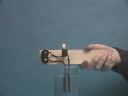
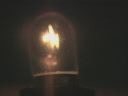
Aqueous sodium chloride lights the bulb brightly. Sodium chloride is a strong electrolyte.
(33)
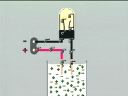
Picture from earlier Animation (a strong electrolyte)
Hydrochloric Acid
 Play movie (10 seconds, .6 MB)
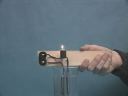
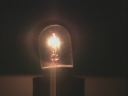
Aqueous hydrochloric acid lights the bulb brightly. Hydrochloric acid is a strong electrolyte.
(33)
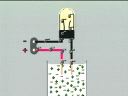
Picture from earlier Animation (a strong electrolyte)
Aqueous Sodium Hydroxide
 Play movie (7 seconds, .4 MB)
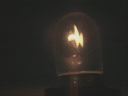
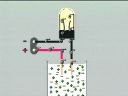
Aqueous sodium hydroxide, a strong electrolyte, lights the bulb brightly.
(33)
Picture from earlier Animation (a strong electrolyte)
Vinegar (Acetic Acid)
 Play movie (11 seconds, .7 MB)
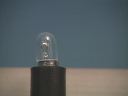
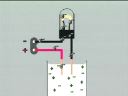
A vinegar solution lights the bulb dimly. Vinegar (or aqueous acetic acid) is a weak electrolyte.
(33)
Picture from earlier Animation (a weak electrolyte)
Aqueous Ammonia
 Play movie (12 seconds, .7 MB)
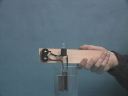
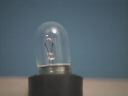
Aqueous ammonia lights the bulb dimly. Ammonia is a weak electrolyte.
(33)
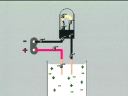
Picture from earlier Animation (a weak electrolyte)
© 1997 Division of Chemical Education, Inc., American Chemical Society. All rights reserved.