
Acid-Base Titrations and Animation
Acetic acid
 Play movie (1 minute 1 second, 3.7 MB)
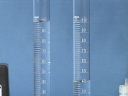
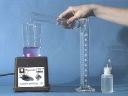
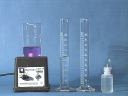
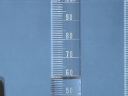
In this simple titration, one graduated cylinder contains 100 mL of sodium hydroxide. The other cylinder contains 40 mL of acetic acid ( a monoprotic weak acid). The 40mL sample of acetic acid is poured into a beaker and a small quantity of indicator is added. The molar concentrations of the two solutions are approximately equal. The solution is stirred as sodium hydroxide is carefully poured from the graduated cylinder into the beaker. As the sodium hydroxide is added, the indicator color begins to change to pink. When a permanent pink color develops, the titration is stopped. The level of sodium hydroxide in the graduated cylinder shows that about 42mL of sodium hydroxide were used to titrate the 40mL sample of acetic acid.
(28)
Slides
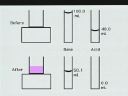
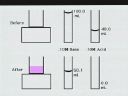
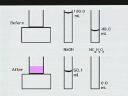
These slides show data helpful in titration calculations, presented with a variety of captions.
Slide 1: Base, Acid
Slide 2: .10M Base, .10M Acid
Slide 3: NaOH, HC2H3O2
(25)
Hydrochloric acid
 Play movie (1 minute 4 seconds, 3.8 MB)
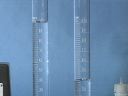
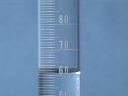
In this simple titration, one graduated cylinder contains 100 mL of sodium hydroxide. The other cylinder contains 40 mL of hydrochloric acid ( a monoprotic strong acid). The 40mL sample of hydrochloric acid is poured into a beaker and a small quantity of indicator is added. The molar concentrations of the two solutions are approximately equal. The solution is stirred as sodium hydroxide is carefully poured from the graduated cylinder into the beaker. As the sodium hydroxide is added, the indicator color begins to change to pink. When a permanent pink color develops, the titration is stopped. The level of sodium hydroxide in the graduated cylinder shows that about 39mL of sodium hydroxide were used to titrate the 40mL sample of hydrochloric acid.
(28)
Slides
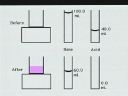
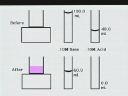
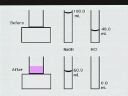
These slides show data helpful in titration calculations, presented with a variety of captions.
Slide 1: Base, Acid
Slide 2: .10M Base, .10M Acid
Slide 3: NaOH, HCl
(25)
Sulfuric acid
 Play movie (1 minute 1 second, 3.6 MB)
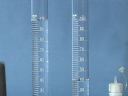
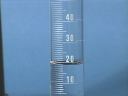
In this simple titration, one graduated cylinder contains 100 mL of sodium hydroxide. The other cylinder contains 40 mL of sulfuric acid ( a diprotic strong acid). The 40mL sample of sulfuric acid is poured into a beaker and a small quantity of indicator is added. The molar concentrations of the two solutions are approximately equal. The solution is stirred as sodium hydroxide is carefully poured from the graduated cylinder into the beaker. As the sodium hydroxide is added, the indicator color begins to change to pink. When a permanent pink color develops, the titration is stopped. The level of sodium hydroxide in the graduated cylinder shows that about 81mL of sodium hydroxide were used to titrate the 40mL sample of sulfuric acid.
(28)
Slides
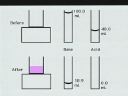
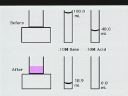
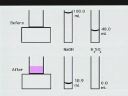
These slides show data helpful in titration calculations, presented with a variety of captions.
Slide 1: Base, Acid
Slide 2: .10M Base, .10M Acid
Slide 3: NaOH, H2SO4
(25)
Acid-Base Titration Animation
 Play movie (57 seconds, 2.7 MB)
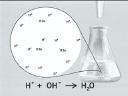
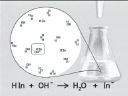
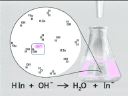
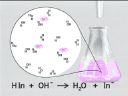
In this animation, both the basic titrant and the acidic sample are clear and colorless. At first we see the titrant reacting with the hydrogen ions in the sample. The reaction produces water from acidic hydrogen ions and basic hydroxide ions. The product of this reaction, water, is clear and colorless, so no change takes place in the sample's appearance as the reaction progresses. When all of the available hydrogen ions in the sample have reacted with hydroxide ions from the buret, we are at the equivalence point. When any more base is added, it reacts with the indicator (HIN), the color change takes effect, and we are at the end point.
(26)
© 1997 Division of Chemical Education, Inc., American Chemical Society. All rights reserved.