
Exploding Soap Bubbles: Hydrogen + Oxygen
Hydrogen alone
 Play movie (34 seconds, 2 MB)


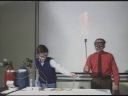
A tank of hydrogen and a tank of oxygen are connected to glass cylinders in which the gases bubble through water to show the rate of flow of each gas. Initially, only hydrogen is bubbled through a tube into a soap solution. Hydrogen-filled soap bubbles float upward and are ignited with a flare. Small explosions are heard as each bubble is ignited.
(16)
with no voice-over
 Play movie (34 seconds, 2.1 MB)


This version of the movie has the same video, but the audio consists of the sound of the experiment only, without the voice-over. Thus it should be easier to hear the different sound levels of the explosions in the three videos.
Hydrogen plus some Oxygen
 Play movie (25 seconds, 1.4 MB)
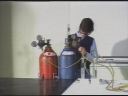
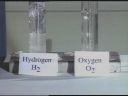
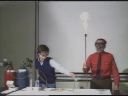
Now oxygen is added to the gas stream, but the oxygen is flowing more slowly than the hydrogen. Again soap bubbles are formed, float upward and are ignited. The bubbles explode more loudly. The hydrogen plus oxygen reaction is occurring more rapidly, because there's oxygen within the soap bubble in addition to the oxygen available in air.
(16)
with no voice-over
 Play movie (25 seconds, 1.5 MB)


This version of the movie has the same video, but the audio consists of the sound of the experiment only, without the voice-over. Thus it should be easier to hear the different sound levels of the explosions in the three videos.
Hydrogen plus more Oxygen
 Play movie (17 seconds, 1 MB)

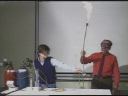
As the oxygen flow is increased, the explosions become even louder. This shows that the ratio of hydrogen to oxygen is important in the reaction of hydrogen with oxygen. When the appropriate ratio is obtained, relatively loud explosions are heard.
(16)
with no voice-over
 Play movie (17 seconds, 1.1 MB)


This version of the movie has the same video, but the audio consists of the sound of the experiment only, without the voice-over. Thus it should be easier to hear the different sound levels of the explosions in the three videos.
Equation Chart

2H2(g)+O2(g) -> 2H2O(g)
Molecular Representation
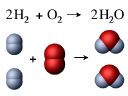
Hydrogen reacts with oxygen to produce water
(79)
Equivalent Amounts
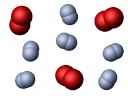
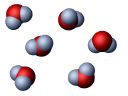
Slide 1: Before the reaction, there are three oxygen molecules and six hydrogen molecules.
Slide 2: After the reaction, six water molecules are present.
(79)
Excess Hydrogen
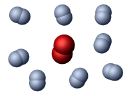
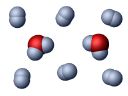
Slide 1: Before the reaction there are eight hydrogen molecules and one oxygen molecule.
Slide 2: After the reaction two water molecules are present. Six hydrogen molecules remain.
(79)
Excess Oxygen
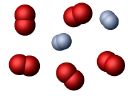
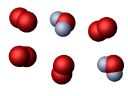
Slide 1: Before the reaction there are five oxygen molecules and two hydrogen molecules.
Slide 2: After the reaction two molecules of water are present. Four oxygen molecules remain.
(79)
© 1997 Division of Chemical Education, Inc., American Chemical Society. All rights reserved.