
Redox Titration and Animation
Highlights of a Redox Titration
 Play movie (1 minute 25 seconds, 5.7 MB)
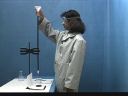
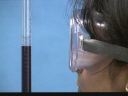
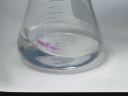
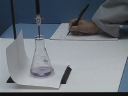
In a titration you measure the quantity of one reactant that is required to consume all of another reactant. To accomplish this, you measure the volume of liquid released from the buret during the procedure. The initial level of the liquid in the buret is observed and recorded. The flask containing the sample to be titrated is placed under the buret. When the purple titrant enters the flask it reacts with the colorless sample. The products of the reaction are colorless. The titrant is a purple solution. The titrant solution in the buret is added to the sample solution in the flask. At this stage, all of the added titrant has reacted within the flask. We know this because the solution in the flask has reverted back to being clear and colorless. Now we are at the end point of the titration, where enough titrant has been added from the buret to react with all of the reactant in the flask, and the solution's color has changed slightly, due to a slight excess of titrant. At this point we can take our final reading.
(27)
Redox Titration Animation
 Play movie (35 seconds, 2 MB)
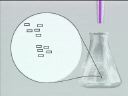
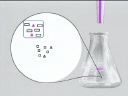
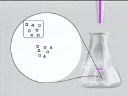
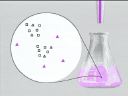
In this animation of an oxidation/reduction titration, at first we see the purple titrant reacting with the colorless sample. The products of this reaction are clear and colorless, so no change takes place in the sample's appearance. When the sample is completely consumed, we are at the equivalence point. When any more titrant is added, the color changes slightly, and we are at the end point. If any more titrant enters the flask, the color darkens and we have overshot the end point.
(26)
© 1997 Division of Chemical Education, Inc., American Chemical Society. All rights reserved.