

|
|
 |
|
 |
|
 |
|
 |
|
 |
|
 |
|
|
|
|
||||||||||||||
Atoms/Electrons |
|
Click the image in the left-hand column below to view the movie. Alternatively, you may use the buttons in the upper right to browse the movies. |
|
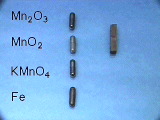 |
Mn oxide capsules Attraction of gel caps filled with potassium permanganate (diamagnetic; zero unpaired electrons), manganese (IV) oxide (paramagnetic; three unpaired electrons), and manganese (III) oxide (paramagnetic; four unpaired electrons) to a strong magnet depends on the number of unpaired electrons. (Companion Demonstration 2.2) The ferromagnetic attraction of iron to a strong magnet is greater than the paramagnetic attraction of the manganese oxide compounds, which is greater than the diamagnetic interaction of the potassium permanganate. (Companion Demonstration 2.3) |
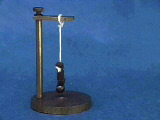 |
Nickel Curie point Nickel is ferromagnetic and is attracted to the hanging magnet. When the temperature of the nickel sphere used here is above its Curie temperature (627 K), the nickel loses its ferromagnetism. As the sphere cools below the Curie temperature, the ferromagnetism returns. (Companion Demonstration 2.4) |
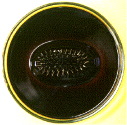 |
Ferrofluid Petri dish The brown ferrofluid is contained in a Petri dish. When a strong magnet is brought underneath, ferrofluid "spikes" are observed along magnetic field lines. (Companion Demonstration 2.6) |
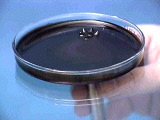 |
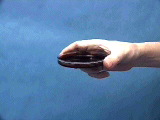
Ferrofluid and magnets The brown ferrofluid is contained in a Petri dish. When a strong magnet is brought underneath, ferrofluid "spikes" are observed along magnetic field lines. At the end of the demonstration, a magnet is shown to be held to the bottom of the dish by its attraction for the ferrofluid (Companion Demonstration 2.6) |
 |
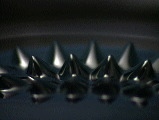
Ferrofluid pour The brown ferrofluid is contained in a Petri dish. When a strong magnet is brought underneath, ferrofluid "spikes" are observed along magnetic field lines. At the end of the demonstration, the ferrofluid is poured out of the dish. (Companion Demonstration 2.6) |
 |
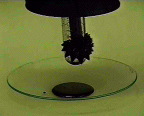
Ferrofluid zoom Ferrofluid "spikes," which are observed along magnetic field lines, form a close-packed array. (Companion Demonstration 2.6) |
 |
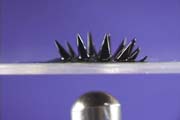
Leaping Ferrofluid "Leaping ferrofluid." When a column of small magnets is lowered inside a tube that is positioned above a puddle of ferrofluid, the ferrofluid will leap toward the magnet, coating the outside of the tube and exhibiting characteristic spikes. If the column of magnets is subsequently raised inside the tube, the ferrofluid will follow upward on the outside of the tube until it reaches a rubber stopper, which causes it to fall back down into its original watchglass container. The outside of the tube has been previously treated with a ferrofluid-resistant film to minimize the amount of ferrofluid that will stick to the tube. (JCE) |
 |
Aqueous-based Ferrofluid Aqueous based ferrofluid can be synthesized as a laboratory experiment. It also responds to a magnetic field. (JCE) |
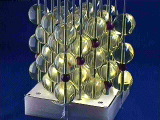 |
Fe3O4 model Structure of the cubic inverse spinel unit cell. This is the structure of the magnetite (Fe3O4) particles that are suspended in the liquid medium of many ferrofluids. (JCE) |
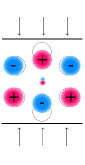 |
Piezoelectricity Superimposed centers of positive and negative charge are represented by the two small dots in the middle of this array of ionic charges. When the crystal is compressed, the centers of positive and negative charge are displaced from one another, creating an electric potential. (Companion Figure 2.18) |
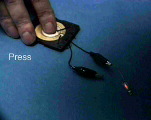 |
Neon bulb and piezoelectric source Compression of a piezoelectric speaker element produces an electric current and lights up the neon bulb. Release of pressure produces an electric current in the opposite direction. The direction of current determines which filament lights up in the neon bulb |
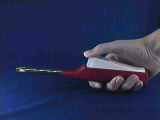 |
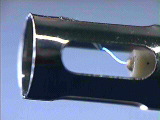
Piezoelectric lighter A piezoelectric lighter containing a ratchet mechanism, which cocks and strikes a piezoelectric crystal, produces a spark that travels several millimeters in air. Piezoelectric lighters are found in gas furnaces, ovens, driers, and barbeque grills. (Companion Demonstration 2.8) |
 |
Piezoelectric spark Magnified view of the spark produced by a piezoelectric lighter (see previous entry). (Companion Demonstration 2.8) |
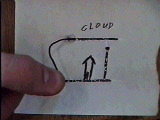 |
Piezoelectric lightning rod A high graphite content pencil has been used to draw the lines of this figure. When electrical leads from a piezoelectric crystal contact two of the pencil lines that are separated by a small gap, the electric field generated by squeezing the crystal provides a voltage that produces a spark that arcs across the gap. This experiment illustrates the use of a lightning rod, shown as the vertical line at the right of the figure. (General Atomics - Larry Woolf) |
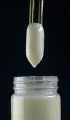 |
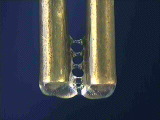
Electrorheology Cornstarch suspended in corn oil runs off uncharged brass electrodes. Application of 5000 V across the brass electrodes induces dipoles in the suspended particles that cause them to align in the electric field, resulting in a change in viscosity of the mixture by several orders of magnitude. (Companion Figure 2.16) |
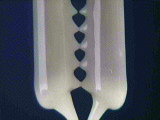 |
Electrorheology (starch) An electrorheological experiment using corn starch in corn oil, showing the formation of filaments, formed by the suspended particles, between the two electrodes when a high voltage is present. (Companion Figure. 2.15) |
 |
Electrorheology (silica) An electrorheological experiment using silica in corn oil, showing the formation of filaments, formed by the suspended particles, between the two electrodes when a high voltage is present. (Companion Figure. 2.15) |
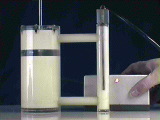 |
Electrorheological shock absorber Demonstration of the use of an electrorheological fluid as a shock absorber: a downward motion of the piston caused by pushing can be arrested by applying a voltage that stiffens the medium. (Companion Figure. 2.17A) |
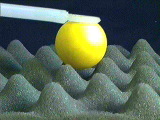 |
Ping-pong ball on foam surface (afm) A mechanical analog of the atomic force microscope: a ball attached to a rod and passed over a foam surface with an array of surface features mimics the movement of a probe tip terminating in a single atom over a crystalline surface. In each case, forces between the probe tip and surface are used to image surface features. (Companion Chapter 2) |
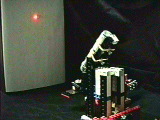 |
Magnetic Force Microscopy (LEGO) A pocket laser, refrigerator magnet and LEGO set mimic magnetic force microscopy. The refrigerator magnet is moved back and forth by a motor underneath a cantilever whose underside has a magnet. As the refrigerator magnet moves, it is alternately attracted to and repelled by the magnet on the cantilever. To amplify this vertical movement, the beam from a pocket laser is bounced off of a mirror that sits on top of the cantilever. The reflected light from the laser beam is observed on a wall. (JCE; Companion Chapter 2) |
 |
Magnetic Force Microscopy (spot) The laser beam oscillates as the refrigerator magnet and magnet on the cantilever (see no. 8) are alternately attracted and repelled by magnetic interactions. (JCE; Companion Chapter 2) |
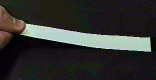 |
Refrigerator magnet A strip can be cut from one edge of a flexible refrigerator magnet and dragged across the back surface of the magnet to mimic the operation of a magnetic force microscope. The probe strip will be alternately attracted and repelled when dragged in one direction and will show a constant interaction with the surface when dragged in the perpendicular direction, because the magnetic field alternates in stripes on the back of the refrigerator magnet. (JCE; Companion Chapter 2) |