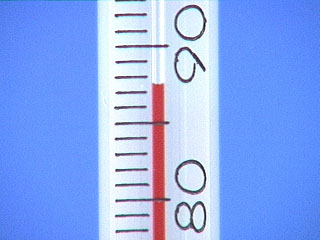
IMAGE. Close-up of a Celcius thermometer.
|
Step 1: Determine the scale increment:
To find the scale increment, subtract the values of any two
adjacent labeled graduations and divide by the number of intervals
between them.
 What is the scale increment for the thermometer? Answer
For the thermometer, first subtract 90°C - 80°C = 10°C. Next, count that ten intervals are between the labeled graduations. Therefore, the scale increment is 10°C/10 graduations = 1°C/graduation. Step 2: Use the graduations to find all certain digits:
Use the labeled graduations and the scale increment to find the certain digits in the measurement.
What are all of the certain digits for the thermometer? Answer
The temperature is greater than 80°C, since the last labeled graduation below the meniscus is 80°C. Next, use the scale increment. There are seven graduation marks below the meniscus, and each graduation represents 1°C, so the certain digits of the reading are 87°C. Step 3: Estimate the uncertain digit and obtain a reading:
Estimate the distance that the meniscus lies between the two graduations as a decimal fraction and multiply by the scale increment.
What is the temperature you should record? Answer
The bottom of the meniscus is about seven tenths of the way between the two graduation marks. Thus, the uncertain digit is calculated as (0.7 increment) * (1°C/increment) = 0.7°C. And, the temperature to be recorded is 87.7°C. |


