Interactions of Light with Solutions and Suspensions - Apparatus | |
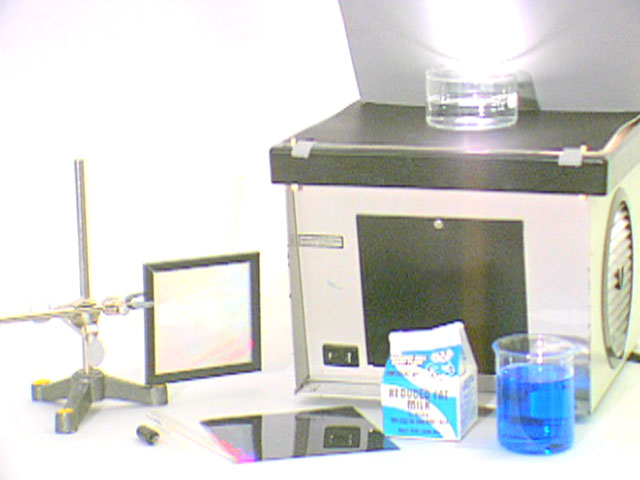
The equipment and methods used to study what happens to light when it passes through solutions and suspensions are described. Discussion In this section we compare the effects on a beam of light passing through a colloidal suspension (skim milk in water) with those on a beam of light passing through a colored solution (copper sulfate in water). The apparatus we use includes an overhead projector, an opaque cardboard sheet with a small square aperture cut in the center covering the glass stage of the projector, and a white cardboard screen set at an angle above the projector. When the projector lamp is turned on, a beam of light passes through the aperture and strikes the screen above. When the cylindrical glass container is moved into position over the aperture, the beam of light passes upward through the solution or colloidal suspension that is in the container. A solution is a homogeneous mixture of two components. The size of the molecules and ions in a solution, typically a few nanometers, is much smaller than the wavelength of visible light. A colloid, or dispersed phase, is defined as a stable system of small particles that is dispersed in another medium. "Small" in this context is vague, but for the casein micelles in the skim milk used in these movies, it means a diameter between 100 and 200 nm - many times the size of particles in a true solution. Other examples of colloids are smoke, India ink, and Jello™. | |
| Table of Contents | Next Page |