Diffraction of Light | |||||||||||
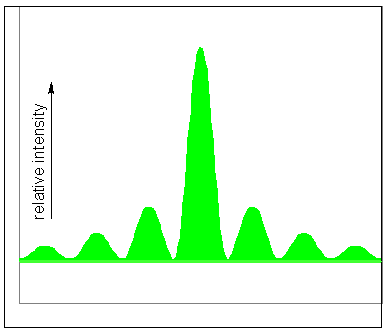
Diffraction of red and green light by patterns on a diffraction plate is shown. As discussed below, the distance between adjacent diffraction minima (nodal regions) in both single and double slit diffraction patterns is proportional to the wavelength of the light. In these photographs, comparison of the center-to-center separation of diffraction minima in the diffraction patterns for red and green light should be made between adjacent diffraction minima on one side of the center of images for red and green light. You can use the ruler in the background of each slide to do this. If you compare the single-slit diffraction patterns for red and green light with single-slit diffraction patterns in a ripple tank (see the section "Wave Diffraction by an Opening in a Barrier"), you will notice a striking difference: single-slit diffraction patterns with light have multiple bright diffraction maxima (antinodal regions) and dark diffraction minima (nodal regions), while the single-slit diffraction patterns in the ripple tank movies have only a single antinodal region. This difference is due to the very great difference in the wavelength to slit-width ratio for light waves and water waves. The distance between dark diffraction minima (nodal regions) in single slit diffraction patterns for light of one color is proportional to λ/a, where λ is the wavelength of the light and a is the slit width; thus the center-to-center separation of diffraction minima increases with increasing wavelength and decreases with increasing slit width. The two figures below are representations of single slit diffraction patterns of red and green light. The distance between nodal regions is larger for red light than for green, which tells us that red light has a longer wavelength than green light. This effect can be seen in the photographs of single-slit diffraction patterns for red and green light. REPRESENTATION OF SINGLE-SLIT DIFFRACTION PATTERNS 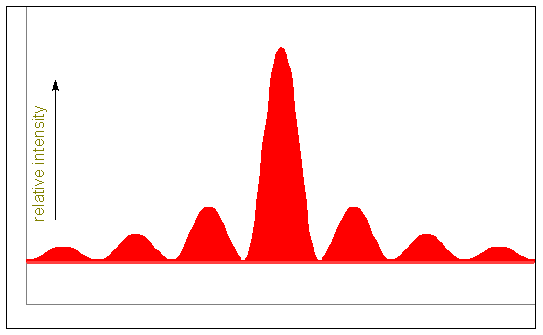
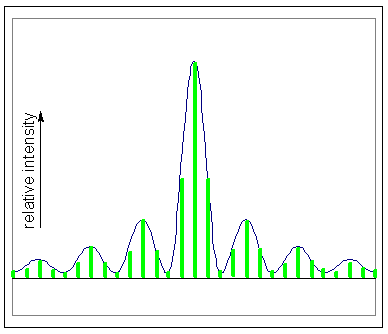
Diffraction patterns for two slits are more complex. There is an envelope of light intensity that resembles that of a single-slit diffraction pattern, but within this envelope are much narrower, equally spaced diffraction maxima and minima. These maxima and minima are the result of interference between the diffraction patterns of the two slits. In the same way as with single slit diffraction patterns, the center-to-center separation of the maxima and minima of the envelope of light intensity depends on λ/a, where, λ is the wavelength of the light and a is the slit width. The center-to-center separation of the narrow maxima and minima within this envelope is proportional to λ/d, where λ is the wavelength of the light and d is the distance between individual slits. Thus the distance between diffraction minima in double-slit diffraction patterns increases with wavelength. The two figures below represent double-slit diffraction patterns for red and green light. The separation of diffraction minima is larger for red light than for green light, consistent with the greater wavelength of red light. REPRESENTATION OF DOUBLE-SLIT DIFFRACTION PATTERNS 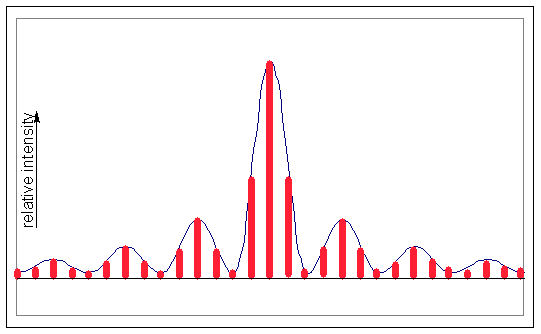
Diffraction patterns for arrays of multiple slits, called diffraction gratings, resemble those for two slits. Typically, diffraction gratings are composed of a large number of parallel equally spaced slits. The effect of more slits is to make the diffraction maxima brighter (more slits means more light passes through) and narrower. As with a double slit diffraction pattern, the center-to-center separation between diffraction minima in the diffraction pattern of such a grating depends λ/d, where d is the center-to-center slit separation. As the distance between slits decreases, the separation of diffraction maxima and minima increases. One of the patterns (pattern G) on the diffraction plate used in this section on the diffraction of light is a diffraction grating with ten 0.06 mm wide slits separated by 0.250 mm. The center-to-center separation of diffraction minima for this grating is the same as that for diffraction minima for the double slits with 0.250 mm slit separations. In later movies, a diffraction grating with 750 slits per millimeter is used - in other words, with a center-to-center slit separation of 1.33 x 10⁻³ mm. With this grating, diffraction maxima for a given wavelength of light are very narrow; they are also very widely separated - nearly 200 times farther apart than with the 10 slit grating used here. | |||||||||||
| Table of Contents | Next Page | ||||||||||