Example of a Mechanical Wave | |
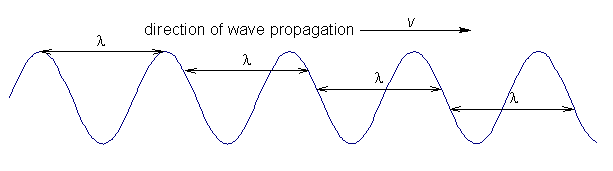
Waves in water serve as an example of a mechanical wave. Discussion A mechanical wave is caused by a disturbance in a material. A familiar example of what we mean by a wave is a set of ripples moving along the surface of a pool of water. A ripple tank, such as that shown in the accompanying movie, makes it easy to study such waves. Waves generated by a bar moving up and down on the surface of the water travel across the tank. An image of the waves in the ripple tank is projected on the floor beneath the tank. We will discuss in more detail how ripple tank images are formed in the section Waves in a Ripple Tank. As a wave passes a particular location in the ripple tank, the water "particles" at that location oscillate about their original positions, but after the disturbance has moved on, there is essentially no permanent displacement of water "particles" from their original positions. What does move with a wave is energy, energy provided by the wave source. The shape or form of waves in the direction of movement can often be closely approximated by a sinusoidal wave. In the illustration below, a sinusoidal wave moves to the right with speed v.
We need to define four terms: the period, the frequency, the wavelength, and the speed of a wave. The period T, measured in seconds, is defined as time it takes for a wave to move a distance equal to one wavelength. The frequency ƒ measured in seconds-1 (reciprocal seconds), is defined as the reciprocal of the period, 1/T, and is equal numerically to the number of wave crests passing a fixed point during a one second interval. The wavelength λ, measured in meters, is defined as the distance between successive corresponding points on a wave form. With these definitions of period, frequency, and wavelength, the wave speed, measured in meters/second, is given by v = λ/T = ƒλ The frequency of water waves in a ripple tank is the same as that of the bar that generates them. This is true of mechanical waves in general: the frequency of the wave is same as the frequency of the device or object that generates the wave. Wave speed is a constant throughout a material with uniform properties. In such cases, wavelength is inversely proportional to frequency. If the properties of the material in which a wave moves are not uniform, as, for example, in a ripple tank in which the depth of water varies, then wave speed is not a constant. In such cases, as frequency increases, the wavelength decreases, but will not be the same everywhere in the material. | |
| Table of Contents | Next Page |