
Oxidation States of Vanadium
A yellow vanadium(V) solution is poured over zinc amalgam. Swirling the mixture produces, in succession, blue vanadium(IV), green vanadium(III) and purple vanadium(II) solutions.
(170 )
Keywords
descriptive chemistry, electrode potentials, oxidation state/number, redox reaction, transition elements/metals
Multimedia
 Play movie
(QuickTime 3.0 Sorenson, duration 73 seconds, size 5.1 MB)
Play movie
(QuickTime 3.0 Sorenson, duration 73 seconds, size 5.1 MB)
A yellow solution of vanadium in its plus five oxidation state is poured into a large flask containing a zinc amalgam. The zinc serves as a reducing agent for the vanadium species. In the process, the zinc is oxidized to zinc(II) ion. When the flask is swirled, the vanadium changes to a light blue, indicating a plus four oxidation state. Swirling increases the contact between the zinc amalgam and the aqueous vanadium solution. Further reduction produces a deep green vanadium plus three solution. With even more swirling in the amalgam, the vanadium is ultimately transformed to purple vanadium plus two.
 Vanadium in its plus five oxidation state. |
 ... in a plus four oxidation state. |
 ... in a plus three oxidation state. |
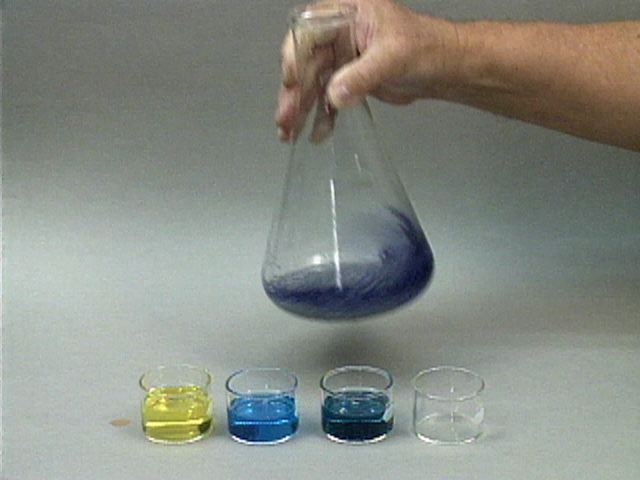 ... in a plus two oxidation state. |
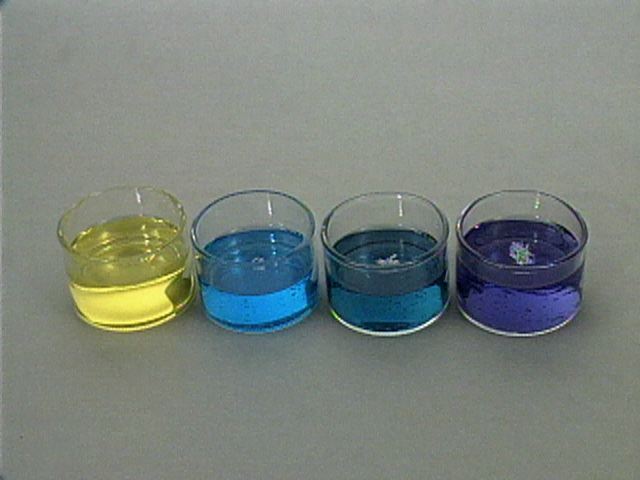 A comparison of the four oxidation states. |
Additional still images for this movie
Discussion
Because each successive reduction potential is smaller, it is possible to attain a stepwise reduction from VO2- to VO2- to V3+ and finally to V2+. The reduction potentials in 1M H+ are 1.000V, 0.337V, and 0.255 V. The V2+ species is unstable in acid solution, since it will reduce H+ to H2.
The green V3+ species is particularly difficult to obtain. Over stirring with the zinc amalgam can lead to the premature formation of the purple V2+.
Demonstration Notes, Warnings, Safety Information, etc.
Exam and Quiz Questions
1. What is the role of the zinc amalgam in this demonstration? Why was the flask swirled?
2. Is the vanadium being oxidized or reduced as the flask is swirled?
3. In this demonstration, the reduction of the vanadium occurs stepwise (one electron at a time). What does this tell about the relative values of the reduction potentials? Do they increase or decrease in the series VO2- --> VO-, VO- --> V3+, V3+ --> V2+? What color changes would you expect if the order of the reduction potentials was reversed?