
Blue Bottle, Red and Blue Bottle
Color changes are caused by reactions of oxygen in the air with chemicals in a solution. The colors fade over time, but can be regenerated by shaking the flask containing the solution.
(150 )
Keywords
kinetics/rates /mechanisms, oxygen, redox reaction
Multimedia
Blue Bottle
 Play movie
(QuickTime 3.0 Sorenson, duration 68 seconds, size 4.4 MB)
Play movie
(QuickTime 3.0 Sorenson, duration 68 seconds, size 4.4 MB)
Methylene blue indicator solution is added to a solution containing dextrose and potassium hydroxide. When the solution is shaken, it becomes intensely blue. The color fades after several seconds, but can be re-established by shaking. This process can be repeated several times although the color changes after many shakes.
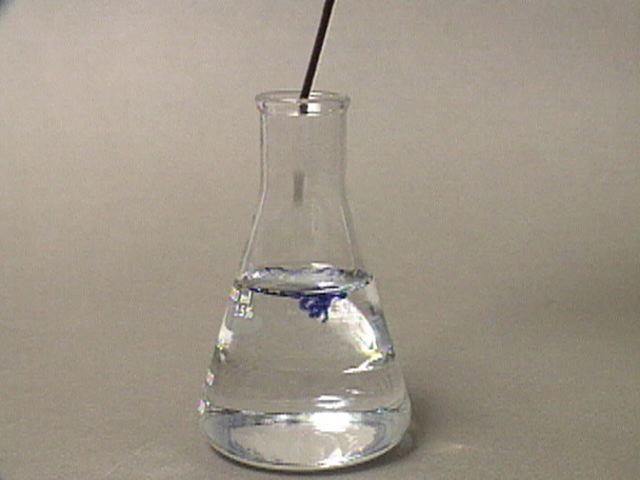 Methylene blue indicator being added dextrose and potassium hydroxide. |
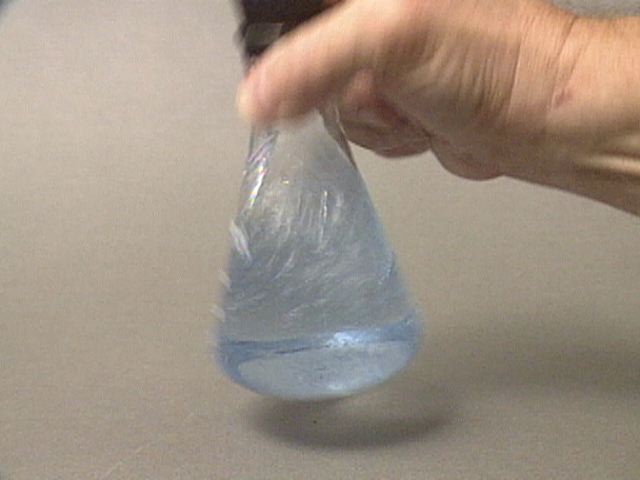 Early in the shaking. |
 Later in the shaking. |
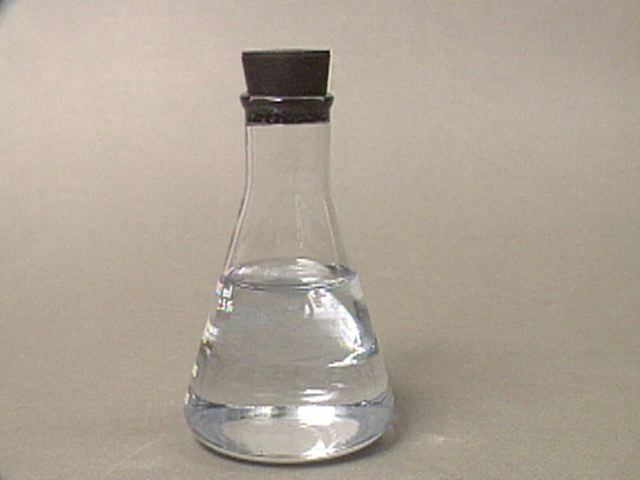 After sitting. |
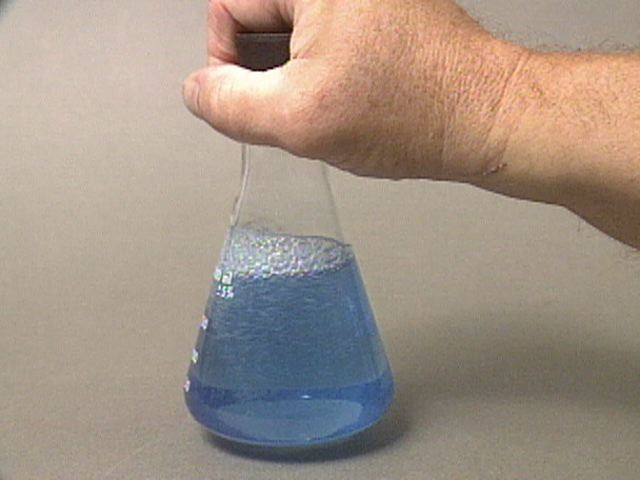 Shaking again. |
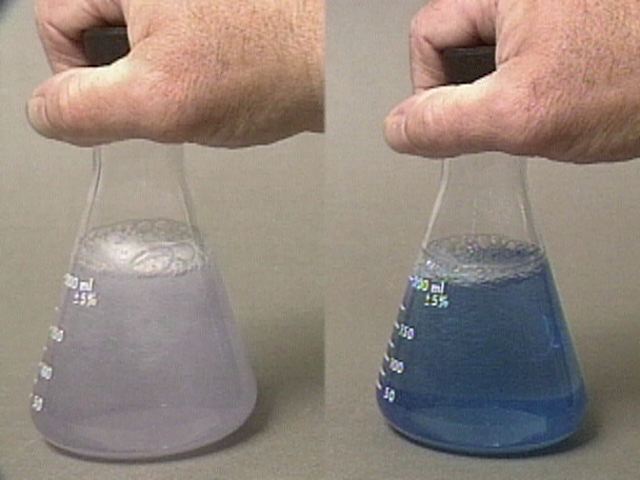 During later shakes. |
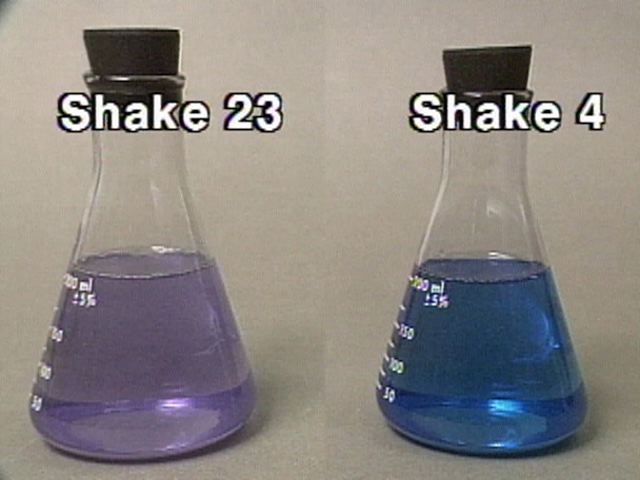 After later shakes. |
Additional still images for this movie
Red Bottle
 Play movie
(QuickTime 3.0 Sorenson, duration 82 seconds, size 5.5 MB)
Play movie
(QuickTime 3.0 Sorenson, duration 82 seconds, size 5.5 MB)
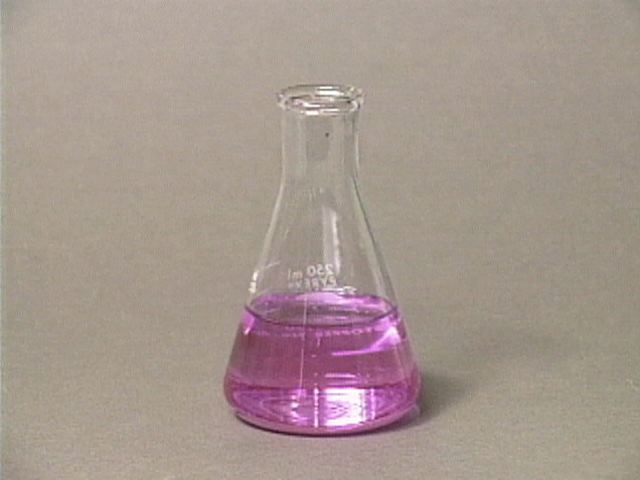
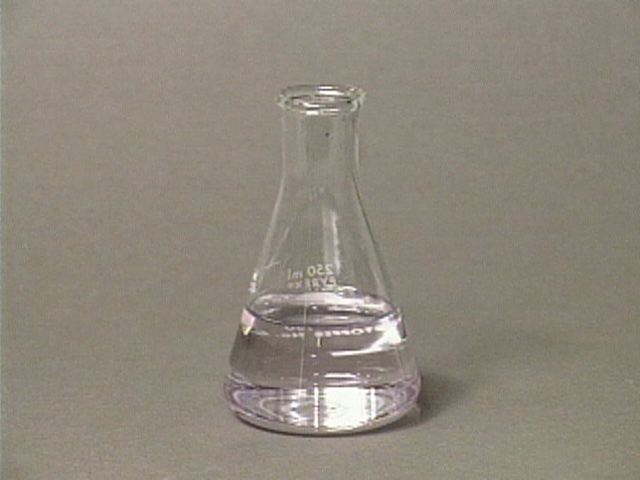
Methylene blue indicator is added to a pink solution of resazurin, dextrose and potassium hydroxide. When the solution is shaken it becomes intensely blue. After a short time the blue color fades yielding a pink solution which then fades to clear. Shaking the solution re-establishes the blue color.
 |
 |
 |
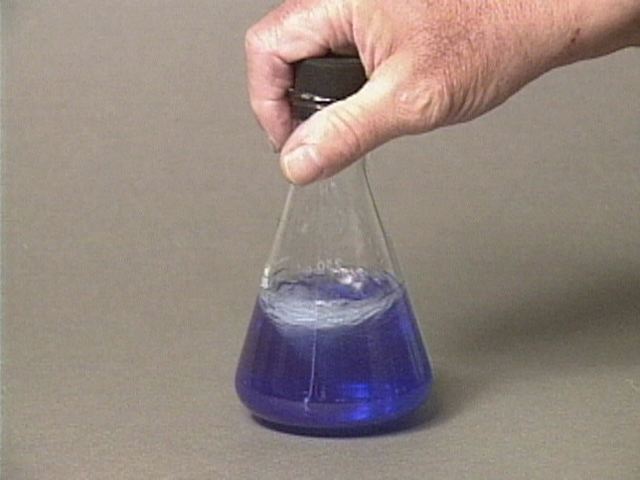 |
Additional still images for this movie
Discussion
Blue Bottle
If the solution is allowed to stand, methylene blue is reduced by dextrose to a colorless form. When the flask is shaken, oxygen dissolves from the air, oxidizing the methylene blue back to its blue form.
Red Bottle, Blue Bottle
Resazurin is irreversibly reduced by dextrose to a fluorescent red that is reversibly reduced to a colorless form. The colorless compound is readily oxidized back to the red form. More vigorous shaking dissolves enough oxygen to also oxidize the methylene blue.
Both experiments
The rate at which these reactions proceed is proportional to temperature, and thus they can be used as kinetics experiments.
This reaction has been described a number of times in the Journal of Chemical Education, and the following references may be useful to those who show the video:
1. Campbell, J. A. J. Chem. Educ. 1963, 40, 578.
2. Adamcíková, L'ubica; Sevcík, Peter J. Chem. Educ. 1998, 75 1580.
3. Vandaveer, Walter R. IV; Mosher, Mel J. Chem. Educ. 1997, 74 402.
4. Cook, A. Gilbert; Tolliver, Randi; Williams, Janelle E. J. Chem. Educ. 1994, 71 160.
Demonstration Notes, Warnings, Safety Information, etc.