
Electrolysis of Water
Sodium Sulfate Solution
 Play movie (40 seconds, 1.7 MB)
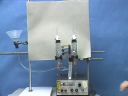
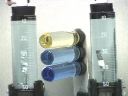
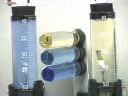
Two cylinders containing a sodium sulfate solution are connected with tubing. Each has a platinum electrode connected to a power supply. Bromothymol Blue indicator is in the sodium sulfate solution. The top vial shows the indicator color in the acid, the middle in neutral solution, and the bottom in base. When electricity passes through the system, oxidation occurs at one electrode and reduction at the other. Gas is formed at each electrode, and the acidity increases at one electrode and decreases at the other.
(32)
Sulfuric Acid Solution
 Play movie (1 minute 8 seconds, 3.9 MB)
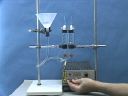
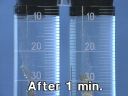
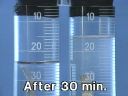
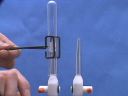
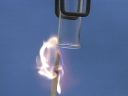
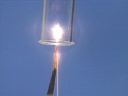
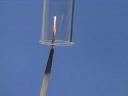
Two cylinders containing sulfuric acid dissolved in water are connected with tubing. When electricity passes through the system, oxidation occurs at one electrode and reduction at the other. Electrolysis of the water generates hydrogen gas at one electrode and oxygen at the other. The role of the sulfuric acid is to allow transfer of charge from one platinum electrode to the other. As the time lapse shows, the volume of gas collected at each electrode differs. The volume of gas generated at each electrode can be determined from the volume readings on the cylinders. When gas from the left cylinder is collected in a test tube and a lighted match is brought near it, the gas ignites with a barking noise, indicating hydrogen. When a glowing match is brought near gas from the right cylinder, the match burns brightly, indicating the presence of oxygen.
(32)
Animation of Electrolysis
 Play movie (1 minute 13 seconds, 4 MB)
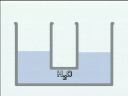
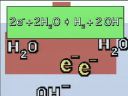
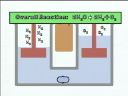
This animation simulates the electrolysis of a neutral aqueous solution, such as sodium sulfate. At the anode, water molecules produce oxygen gas, hydrogen ions, and electrons. The electrons flow through the circuit to the cathode, where they react with water to produce hydrogen gas and hydroxide ions. If the solution is stirred, acid-base neutralization will occur.
(31)
© 1997 Division of Chemical Education, Inc., American Chemical Society. All rights reserved.