
Reactions of Metals + Iodine
Aluminum
 Play movie (1 minute 21 seconds, 4.6 MB)
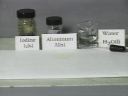


Powdered aluminum and powdered iodine are mixed together and then one or two drops of water are added to the mixture. Shortly after the water is added, a vigorous reaction occurs. There is flame and lots of iodine vapor given off. Some of the iodine vapor can be seen to be reacting to form some other substance because the color is no longer violet but kind of a reddish brown. This vigorous reaction shows that aluminum metal is a fairly strong reducing agent and iodine solid is a fairly strong oxidizing agent.
(43)
Manganese
 Play movie (1 minute 11 seconds, 4.1 MB)
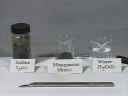


Manganese is mixed with iodine. Notice that the powdered manganese is black, and the iodine is also nearly black. Again there is no reaction just upon mixing the solid materials but as soon as a few drops of water are added, a reaction does take place. Again the reaction is vigorous, but this time there is no flame. By comparison with the aluminum reaction, the manganese reaction was not as vigorous.
(43)
Iron
 Play movie (1 minute 8 seconds, 3.9 MB)


Powdered iron is mixed with some iodine. There is no reaction when the dry solids are mixed together. In this case, adding water initiates a reaction but it is not as vigorous as the reaction of the aluminum or the manganese. Apparently iron is not as strong a reducing agent as these other metals relative to iodine.
(43)
Nickel
 Play movie (1 minute 1 second, 3.4 MB)


Nickel is mixed with iodine. Even after water is added, there is no reaction between the nickel and the iodine. Apparently, nickel is not a very strong reducing agent compared to the other metals tested.
(43)
Zinc
 Play movie (1 minute 6 seconds, 3.6 MB)
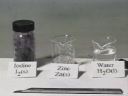


Granular zinc is mixed with iodine and there is no reaction when the two dry solids are mixed together. When water is added to this mixture, there is a reaction approximately as vigorous as the reaction of the manganese with the iodine, showing that zinc and manganese are roughly equivalent in reducing strength, and are stronger than iron and nickel, but not quite as strong as aluminum.
(43)
Zinc Iodine Reaction
Picture of the reactants

0.28 g Zn 1.2 g I2
Movie of the reaction
 Play movie (27 seconds, 1.6 MB)


When powdered zinc and solid iodine are mixed, no reaction is observed. When water is added to the mixture, the exothermic reaction raises the temperature enough to vaporize iodine.
(37)
Aluminum Iodine Reaction
Picture of the reactants

0.1 g Al 1.2 g I2
Movie of the reaction
 Play movie (53 seconds, 3.1 MB)


When powdered aluminum and solid iodine are mixed, no reaction is observed. When water is added to the mixture, the exothermic reaction raises the temperature enough to vaporize iodine.
(37)
© 1997 Division of Chemical Education, Inc., American Chemical Society. All rights reserved.