
Combination Reactions
Reaction of Potassium and Bromine
 Play movie (1 minute 10 seconds, 4.2 MB)
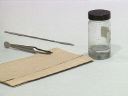
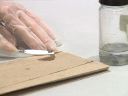
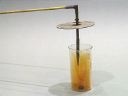
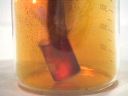
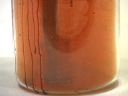
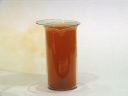
Because of its high reactivity, potassium metal is stored in mineral oil, a relatively inert liquid. The protective coating of mineral oil must be removed from the metal's surface. The soft potassium will then be cut, and a small piece will be picked up with forceps and carefully added to a small beaker of liquid bromine. The large covered beaker prevents the escape of bromine vapor and reaction products into the environment.
(36)
Portion with no voice-over
 Play movie (4 seconds, .5 MB)
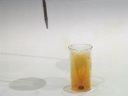
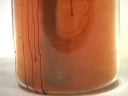
This is a portion of the movie having the same video, but the audio consists of the sound of the experiment only, without the voice-over.
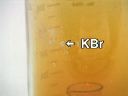
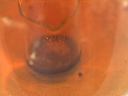
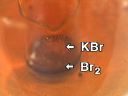
Products of the reaction
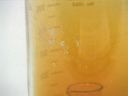
Slide 1: Unlabeled still of KBr
Slide 2: Labeled still of KBr
Slide 3: Unlabeled still of KBr + Br2
Slide 4: Labeled still of KBr + Br2
Molecular representation
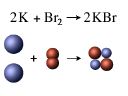
Symbolic and molecular representations of the formation reaction between potassium and bromine to produce potassium bromide.
(79)
Reaction of Sodium and Chlorine
 Play movie (51 seconds, 3.1 MB)
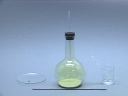
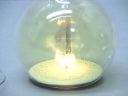

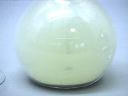
A small piece of sodium metal is placed in a flask containing yellow chlorine gas. The flask also contains sand to prevent the heat which will be generated by the reaction from cracking the glass. Initially, no reaction is observed between the sodium and the chlorine. The reaction will be initiated by adding a drop of water to the sodium.
(29)
© 1997 Division of Chemical Education, Inc., American Chemical Society. All rights reserved.