
Acids and Bases: An Introduction

|
Home |
|
Table of Contents |
|
Introduction |
|
Molecular Structure |
|
Ionization Constants |
|
Salts |
|
Buffers |
| Lewis Theory |
Autoionization of Water
If water can act as an acid or base, can a water molecule react with another water molecule, one acting as a base and accepting a proton from the other? The chemical equation for this reaction would be:
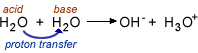
Pure water does conduct a very weak electrical current; this current occurs due to the above reaction producing H3O+ and OH- ions. This reaction is very reactant favored; the concentration of H3O+ has been measured as only 1 x 10⁻⁷ M. This measurement was done at 25º C and will vary slightly at other temperatures. |
 |
Why and how does [H3O+] depend on temperature? |
Since this reaction is an equilibrium, an equilibrium constant expression can be written:
 |
Kw = [H3O+] [OH-] | |
Why isn't H2O in Kw? |
The equilibrium constant for this reaction is called Kw.
NOTE: Chemists often use H+ to represent H3O+. With this notation, the ionization of water would be written: 
It is important to remember that even if H+ (aq) is written, the proton is hydrated and present in solution as H3O+. |
 What
is the value of Kw at 25º C?
What
is the value of Kw at 25º C?
| 1 x 10⁻⁷ | 1 x 10-14 | There is not enough information given. |
 |
|
|
 Kw
is equal to the H3O+ concentration multiplied
by the OH- concentration. If the H3O+
concentration is 1 x 10⁻⁷ M, what must the OH-
concentration be? (HINT: The stoichiometry of the above equation
tells you that one OH- ion is formed every time an H3O+
ion is formed.)
Kw
is equal to the H3O+ concentration multiplied
by the OH- concentration. If the H3O+
concentration is 1 x 10⁻⁷ M, what must the OH-
concentration be? (HINT: The stoichiometry of the above equation
tells you that one OH- ion is formed every time an H3O+
ion is formed.)
Good!
Remember that this value for Kw is
only correct at 25º C. However, it is often used at other temperatures
as an approximate value.
If
a strong acid is added to pure water, what will happen to the H3O+
and OH- concentrations?
| [H3O+] : | increase |
[OH-] : | increase |
|||
| decrease |
decrease |
|||||
| stay
the same |
stay
the same |
|||||


