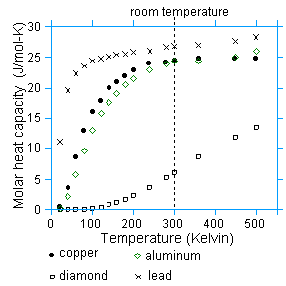
Table of molar heat capacity data for selected solids.Plot of molar heat capacity data vs. temperature.There is (1/2) RT of energy for each degree of freedom. For a monatomic gas, kinetic energy = 3/2 RT and molar heat capacity is (3/2) R.Consider atoms in a monatomic solid as bonded by springs, having both potential and kinetic energy: there are six degrees of freedom, and molar heat capacity is 3 R.All vibrations must be excited to achieve a value of 3 R, the so-called Law of Dulong and Petit.Noted exceptions: Be, B, and C => unusually low values due to relatively high vibrational frequencies as a result of their low masses.For salts, all atoms contribute so that a molar heat capacity of 3 Rp is expected, where p is the number of atoms in the salt's chemical formula.
|