|
Home
Table of Contents
Keyword Index
Textbook X-ref
Search
About CCA!
|
 |
| Extraction of Dichloroindophenol |
| |
Click a thumbnail picture below to view a larger version. |

View Movie |
|
Narrative
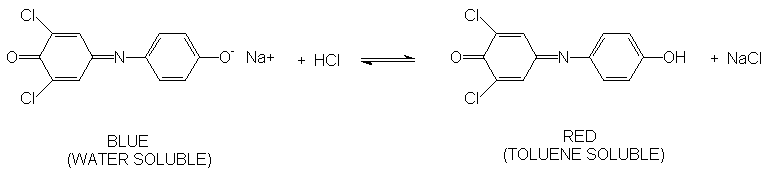
A few drops of hydrochloric acid are added to a separatory funnel containing an aqueous solution of the blue sodium salt of 2,6-dichloroindophenol and toluene. The less dense toluene is the top layer. The funnel is shaken and vented. The aqueous layer becomes clear and the toluene layer is red. A few drops of sodium hydroxide are then added. The blue 2,6-dichlorophenoxide anion is polar and water soluble. Red 2,6-dichlorophenol is nonpolar and soluble in the nonpolar solvent toluene. After shaking, the mixture is restored to its original state.
Discussion
An aqueous solution of the blue sodium salt of 2,6-dichloroindophenol is placed in a separatory funnel containing toluene. The less dense
toluene is the top layer. A few drops of 2M HCl are added and the funnel shaken. The aqueous layer becomes clear and the toluene becomes
red. A few drops of sodium hydroxide are then added and, after shaking, the mixture is restored to its original state.
The blue 2,6-dichlorophenoxide anion is polar and water soluble. Red 2,6-dichlorophenol is nonpolar and soluble in the nonpolar solvent toluene. This is an example of the general rule for solubility - "like dissolves like".
|