|
Home
Table of Contents
Keyword Index
Textbook X-ref
Search
About CCA!
|
 |
| Solvolysis of Bromobutane Isomers |
 |

View Slide Thumbnails |
|

View Next Movie |
|
Voiceover
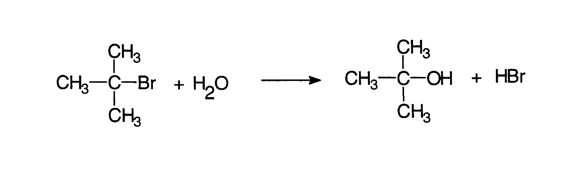
Isomers of bromobutane are added to an alkaline aqueous acetone solution containing bromcresol green indicator. The solvolysis is revealed by the indicator changing from green to red as hydrogen bromide is liberated in the reaction. The tertiary halide 2-bromo-2-methylpropane reacts fastest. The secondary halide 2-bromobutane reacts next followed by the more hindered primary halide 1-bromo-2-methylpropane. The primary 1-bromobutane does not react under these conditions. The order of reactivity is characteristic of an SN1 reaction mechanism.
Discussion
Isomers of C4H9Br were added to an alkaline aqueous acetone solution containing bromcresol green indicator. The solvolysis is revealed by the indicator changing from green to red as hydrogen bromide is liberated in the reaction. The tertiary halide 2-bromo-2-methylpropane reacts fastest. The secondary halide 2-bromobutane reacts next followed by the more hindered primary halide 1-bromo-2-methylpropane. The primary 1-bromobutane does not react under these conditions. The order of reactivity of tertiary > secondary > primary halides indicates an SN1 mechanism in which a free carbocation is formed as described in section 10a.
|
Design, Text and Demonstrator:
|
|
| |
Gary Trammell
|
University of Illinois at Springfield, Springfield, IL 62794
|
|
Videographer/Editor:
|
|
| |
Steve Dykema
|
University of Illinois at Springfield, Springfield, IL 62794
|
|
Voice:
|
|
| |
Margaret Biddle
|
University of Wisconsin - Madison, Madison, WI 53706
|
|
Audio Production:
|
|
| |
Greg Minix
|
University of Wisconsin - Madison, College of Engineering, Madison, WI 53706
|
| |
Jerrold J. Jacobsen
|
University of Wisconsin - Madison, Madison, WI 53706
|
|