|
Home
Table of Contents
Keyword Index
Textbook X-ref
Search
About CCA!
|
 |
| Secondary versus Tertiary Halides |
 |

View Slide Thumbnails |
|

View Next Movie |
|
Voiceover
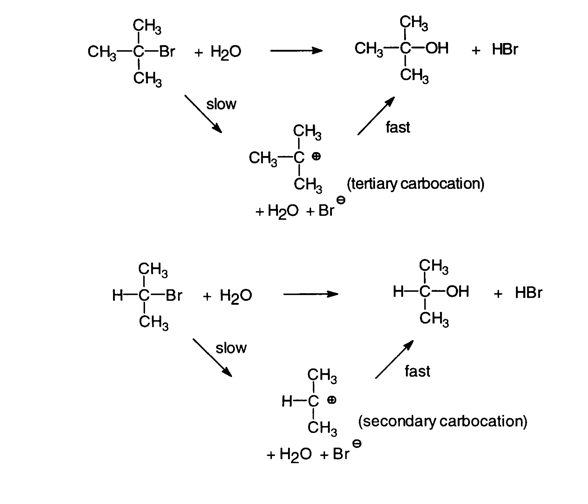
Two test tubes contain acetone and a basic solution of bromcresol green indicator. Isopropyl bromide is added to the first tube and tert-butyl bromide to the second. Production of hydrogen bromide causes the indicator to change color (from green to pink).
Discussion
Two test tubes contain acetone and aqueous sodium hydroxide (2.3 : 1 ratio) and bromcresol green indicator. Isopropyl bromide (2-bromopropane) is added to the first tube and tert-butyl bromide (2-bromo-2-methylpropane) to the second. The tertiary halide 2-bromo-2-methylpropane rapidly undergoes a SN1 reaction releasing hydrogen bromide and causing the indicator to change color from green to pink. The secondary halide 2-bromopropane reacts more slowly. This order of reactivity (tertiary > secondary halide) is characteristic for SN1 reactions in which a carbocation is formed.
|
Design, Text and Demonstrator:
|
|
| |
Gary Trammell
|
University of Illinois at Springfield, Springfield, IL 62794
|
|
Videographer/Editor:
|
|
| |
Steve Dykema
|
University of Illinois at Springfield, Springfield, IL 62794
|
|
Voice:
|
|
| |
Margaret Biddle
|
University of Wisconsin - Madison, Madison, WI 53706
|
|
Audio Production:
|
|
| |
Greg Minix
|
University of Wisconsin - Madison, College of Engineering, Madison, WI 53706
|
| |
Jerrold J. Jacobsen
|
University of Wisconsin - Madison, Madison, WI 53706
|
|