
Overvoltage
Zinc metal reacts with hydrochloric acid, generating hydrogen gas. However, when a strip of nickel, copper, platinum or lead is placed in hydrochloric acid, no reaction is observed. When nickel dipped in hydrochloric acid is brought in contact with zinc, bubbles form on the surface of the nickel metal. Hydrogen also forms on the surfaces of copper and platinum when those metals touch the zinc. When nickel, copper or platinum is connected electrically to the zinc externally (through a wire), bubbles again form on the surface of each of these metals. However, when a piece of lead is brought in contact with the zinc, no bubbles are observed on the surface of the lead.
(131 )
Keywords
descriptive chemistry, electrochemical (galvanic) cells, halogens/halides/hydrohalic acids, metals, reactivity - kinetic/thermodynamic stability, redox reaction, zinc
Multimedia
 |
Zinc in HCl
 Play movie
(QuickTime 3.0 Sorenson, duration 9 seconds, size 751.2 K)
Play movie
(QuickTime 3.0 Sorenson, duration 9 seconds, size 751.2 K)
When a zinc strip is placed in hydrochloric acid, a reaction occurs, generating hydrogen gas bubbles.
 |
Nickel in HCl
 Play movie
(QuickTime 3.0 Sorenson, duration 7 seconds, size 520 K)
Play movie
(QuickTime 3.0 Sorenson, duration 7 seconds, size 520 K)
When a nickel strip is placed in hydrochloric acid, no reaction occurs.
 |
Additional still images for this movie
Nickel and Zinc in HCl
 Play movie
(QuickTime 3.0 Sorenson, duration 33 seconds, size 2.3 MB)
Play movie
(QuickTime 3.0 Sorenson, duration 33 seconds, size 2.3 MB)
A zinc strip placed in hydrochloric acid generates gas bubbles, but a nickel strip in the same solution does not. When the two metals touch, gas is also generated at the nickel strip. When a wire is placed across the two metal strips outside the solution, with the strips not touching inside the solution, again gas is generated at the nickel strip.
 When nickel and zinc touch... |
 ...gas occurs on the nickel. |
 When nickel and zinc are connected... |
 ...gas occurs on the nickel. |
Additional still images for this movie
Copper in HCl
 Play movie
(QuickTime 3.0 Sorenson, duration 9 seconds, size 660 K)
Play movie
(QuickTime 3.0 Sorenson, duration 9 seconds, size 660 K)
When a copper strip is placed in hydrochloric acid, no reaction occurs.
 |
Additional still images for this movie
Copper and Zinc in HCl
 Play movie
(QuickTime 3.0 Sorenson, duration 36 seconds, size 2.5 MB)
Play movie
(QuickTime 3.0 Sorenson, duration 36 seconds, size 2.5 MB)
A zinc strip placed in hydrochloric acid generates gas bubbles, but a copper strip in the same solution does not. When the two metals touch, gas is also generated at the copper strip. When a wire is placed across the two metal strips outside the solution, with the strips not touching inside the solution, again gas is generated at the copper strip.
 When copper and zinc touch... |
 ...gas occurs on the copper. |
 When copper and zinc are connected... |
 ...gas occurs on the copper. |
Additional still images for this movie
Platinum in HCl
 Play movie
(QuickTime 3.0 Sorenson, duration 6 seconds, size 450 K)
Play movie
(QuickTime 3.0 Sorenson, duration 6 seconds, size 450 K)
When a platinum strip is placed in hydrochloric acid, no reaction occurs.
 |
Additional still images for this movie
Platinum and Zinc in HCl
 Play movie
(QuickTime 3.0 Sorenson, duration 29 seconds, size 2 MB)
Play movie
(QuickTime 3.0 Sorenson, duration 29 seconds, size 2 MB)
A zinc strip placed in hydrochloric acid generates bubbles, but a platinum strip in the same solution does not. When the two metals touch, gas is also generated at the platinum strip. When a wire is placed across the two metal strips outside the solution, with the strips not touching inside the solution, again gas is generated at the platinum strip.
 When platinum and zinc touch... |
 ...gas occurs on the platinum. |
 When platinum and zinc are connected... |
 ...gas occurs on the platinum. |
Additional still images for this movie
Lead in HCl
 Play movie
(QuickTime 3.0 Sorenson, duration 6 seconds, size 430 K)
Play movie
(QuickTime 3.0 Sorenson, duration 6 seconds, size 430 K)
When a lead strip is placed in hydrochloric acid, no reaction occurs.
 |
Additional still images for this movie
Lead and Zinc in HCl
 Play movie
(QuickTime 3.0 Sorenson, duration 28 seconds, size 2 MB)
Play movie
(QuickTime 3.0 Sorenson, duration 28 seconds, size 2 MB)
A zinc strip placed in hydrochloric acid generates gas bubbles, but a lead strip in the same solution does not. When the two metals touch, still no bubbles are generated at the lead strip. No gas is generated at the lead strip when the metals are separated in the solution but connected by an external wire, since lead's overvoltage is higher than zinc's overvoltage.
 When lead and zinc touch... |
 ...no gas occurs on the lead. |
 When lead and zinc are connected... |
 ...no gas occurs on the lead. |
Additional still images for this movie
Discussion
The first set of observations is easily explained. Examination of a table of standard reduction potentials indicates that copper and platinum should not reduce H+ to H2. Although the Eo's for the reduction of Ni2+ and Pb2+ to the metals are slightly negative (-0.257 and -0.125 V), experience demonstrates that the reduction potential must be less than -0.6 V before reduction of H+ will take place. Only zinc (Eored of Zn2+ = -0.762 V) meets this standard.
More puzzling is the fact that when nickel, copper or platinum is placed in contact with zinc, bubbles form on the other metal's surface. Zinc is still being oxidized to Zn2+, but now some of the electrons produced in the process are transferred to the other metal, where they combine with H+ to form hydrogen gas. Reduction of hydrogen ions at the metal surface is most favored when metal-hydrogen bonds are of intermediate strength so that the hydrogen will be weakly bound to the metal during electron transfer, but not so strongly bound as to prevent the formation and escape of H2 (see Figure 1). This model accounts for the vigorous bubbling on platinum (the least reactive of the metals in this demonstration), moderate bubbling on nickel and copper, and for the absence of bubble formation on lead.
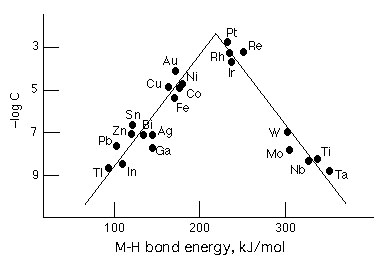
Figure 1. This is a plot of the negative logarithm of the exchange current (C) versus M-H bond energy. Hydrogen gas is evolved most rapidly for metals at the top of the peak.
Demonstration Notes, Warnings, Safety Information, etc.
Exam and Quiz Questions
1. Metal surfaces that promote the tendency of H+ to be reduced to H2 are said to lower the "overvoltage" or "overpotential" of the reaction. Based on your observations, which metal is best at reducing the overpotential for the reduction of H+, compared to a zinc surface? Which is worst?
2. In the experiments where nickel is brought in contact with zinc, would you expect nickel to be oxidized to Ni2+? Explain.
3. If nickel is not oxidized to Ni2+, where does oxidation take place? Explain how it is possible for hydrogen bubbles to form on the surface of the nickel.