
Effusion of Gases
Introduction - movie
 Play movie (27 seconds, 1.5 MB)
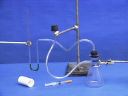
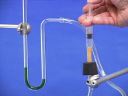
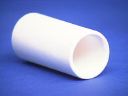
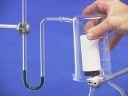
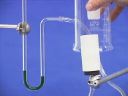
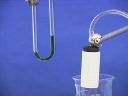
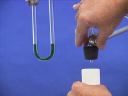
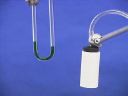
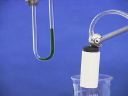
A U-tube containing a green liquid is connected with tubing to a stoppered flask. A syringe is attached to the flask and is used to change the pressure on the green liquid in the U-shaped tube. As you view the following sequences, try to determine what properties of gases affect the pressure.
(32)
Helium He
 Play movie (14 seconds, .9 MB)
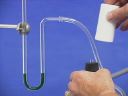
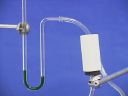
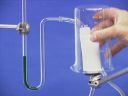
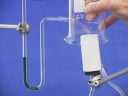
Helium gas molecules have small mass and effuse more rapidly into the porous cup than air molecules effuse out. This generates a higher pressure inside the cup.
(32)
Methane
 Play movie (29 seconds, 1.7 MB)
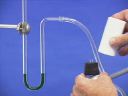

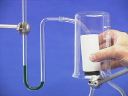
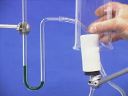
CH4
Methane molecules are heavier than helium molecules, but lighter than air molecules, so they effuse through the cup more slowly than helium. Methane effusion generates a slight increase in pressure within the cup.
(32)
Nitrogen
 Play movie (18 seconds, 1.1 MB)
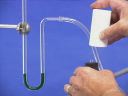

N2
Since air is composed primarily of nitrogen, there is no significant net effusion through the porous cup.
(32)
Oxygen
 Play movie (26 seconds, 1.5 MB)
O2
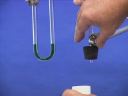
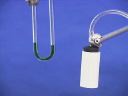
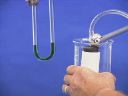
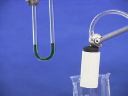
The apparatus has been inverted to work with gases more dense than air. Oxygen, which is slightly more dense than air, causes a very small decrease in pressure within the cup. The pressure decreases because the effusion rate of nitrogen from the air out of the cup is greater than the effusion rate of oxygen into the cup.
(32)
Carbon Dioxide
 Play movie (22 seconds, 1.3 MB)

CO2
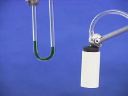
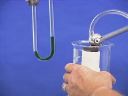
Carbon dioxide molecules are significantly heavier than air molecules, so their effusion rate into the cup is much less than the effusion rate of air out of the cup.
(32)
Sulfur Hexafluoride
 Play movie (15 seconds, .9 MB)

SF6
Sulfur hexafluoride is an extremely dense gas, so its molecules effuse very slowly compared to air molecules.
(32)
© 1997 Division of Chemical Education, Inc., American Chemical Society. All rights reserved.