
Thermodynamic vs Kinetic Control Forming Mercury(II) Iodide
 Play movie (38 seconds, 1.9 MB)
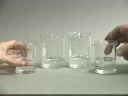
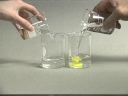
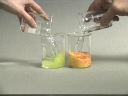
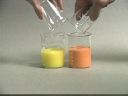
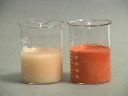
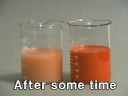
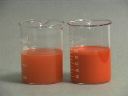
On the left, dilute solutions of mercury(II) and iodide ions are mixed. The mixture immediately turns yellow, indicating the presence of yellow, rhombic mercury(II) iodide. Concentrated solutions of mercury(II) and iodide are in the beaker on the right. The concentrated mixture initially turns yellow, but almost immediately becomes bright orange, indicating the formation of the more thermodynamically stable orange, tetragonal mercury(II) iodide. Over time, the diluted solution turns from peach colored to bright orange, indicating a gradual transformation to tetragonal mercury(II) iodide.
(4)
Loss of mass of Marble due to reaction with Nitric Acid
 Play movie (1 minute 56 seconds, 6.5 MB)
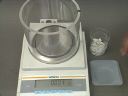
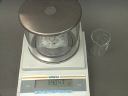
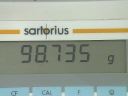
A sample of marble chips is massed on an analytical balance. The chips, calcium carbonate, will be allowed to react with nitric acid to form carbon dioxide, water, and soluble calcium nitrate. This will result in a noticeable loss of mass.
The chips are poured into a beaker, and nitric acid solution is added.
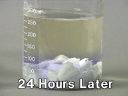
The beaker is viewed two hours later. A color change of the solution and the presence of bubbles indicate that a chemical reaction has occurred. When viewed again later, a more pronounced color change is evident.
24 hours after the addition of the acid, the chips are rinsed, dried, and massed again. They show a noticeable loss of mass.
(18)
© 1997 Division of Chemical Education, Inc., American Chemical Society. All rights reserved.