
Thermite Reaction
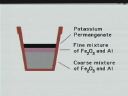
Chart showing layers in flowerpot
(31)
Movie
 Play movie (1 minute 1 second, 3.6 MB)
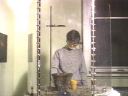
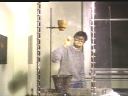
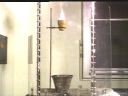
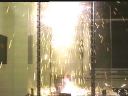
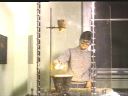
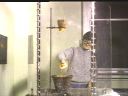
The thermite reaction involves a mixture of iron oxide and aluminum that has been placed in a flower pot and covered with potassium permanganate. Some glycerin is poured over the potassium permanganate and eventually begins to react. When the iron oxide-aluminum mixture is ignited, a very vigorous reaction occurs and a molten metal can be seen dropping from the flower pot into a bucket of sand below. The reaction is extremely exothermic, a great deal of heat is given off. When the product of the reaction is examined a large piece of white hot iron has fallen into the sand at the bottom of the apparatus. This illustrates that aluminum is an extremely strong reducing agent and also that this reaction is very highly exothermic.
(15)
Portion with no voice-over
 Play movie (24 seconds, 1.5 MB)
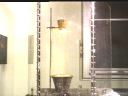
This is a portion of the movie having the same video, but the audio consists of the sound of the experiment only, without the voice-over.
Equation Chart
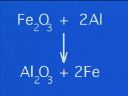
How the reaction was started.
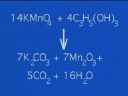
The first step in the thermite reaction is oxidation of glycerine by potassium permanganate, which is demonstrated next.
Oxidation of Glycerine by Potassium Permanganate
 Play movie (36 seconds, 1.9 MB)
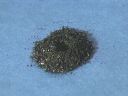
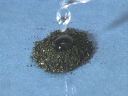
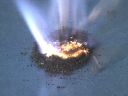
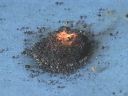
A few drops of glycerin are placed into a hollow in a pile of potassium permanganate. Potassium permanganate is a strong oxidizing agent and glycerin is an easily oxidized substance. Consequently, a redox type reaction is expected between these two substances. An exothermic reaction does occur, with the glycerin boiling, giving off smoke and eventually producing a flame that spreads around the pile of potassium permanganate. Eventually all the glycerin is consumed by the permanganate.
(37)
Equation Chart
© 1997 Division of Chemical Education, Inc., American Chemical Society. All rights reserved.