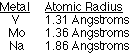
Which two metals are most likely to form a solid solution?
V and Mo, V and Na, Mo and Na
Additional example:

Which two elements are most likely to form a solid solution?
C and Si, C and Ge, Si and Ge
yes, no
Considering only these hydrogen isotopes, how many masses (integer amu)
can occur?
3, 5, 9

Which other numbered atoms define the tetrahedral hole?
1 and 3, 8 and 9, 13 and 14
At what value of z is its center?
0, 1/4, 1/2, 1

plot A represents the volumes of the two gases (H2S and H2Se) and plot B represents the masses of the two gases
plot A represents masses of the two gases and plot B represents volume of the two gases
Which of the two curves in plot B represents the mass of H2S?
1, 2
In which part of either plot is the acid the limiting reagent?
flat part
rising part

Flask A, Flask B

How many buckyball molecules are in the unit cell?
4, 6, 8
Potassium reacts with C60 to fill all the tetrahedral and octahedral holes of the FCC structure formed by the C60 molecules. What is x in the formula of the solid, KxC60? [The solid is a superconductor.]
1,2,3,4

A, B, C
How many total heads are included in the correct unit cell?
4, 6, 8
(A digital camera can be used to quickly photograph students in an entire
class at the beginning of a course; groups of several students can be photographed
at a time, with subsequent computer cropping to produce individual pictures.
The collection of class photographs can be distributed to everyone in the
course with their preferred name to facilitate communication. These photographs
can also be incorporated into a unit cell question, as shown above.)
237. Scanning tunneling microscopy depends upon the flow of electricity (current) between a surface and an atomically-sharp probe tip. Two plots of current vs. tip-to-surface distance are shown. Which is correct?

A, B


More questions are needed for this section. Please submit contributions
to concept@chem.wisc.edu..